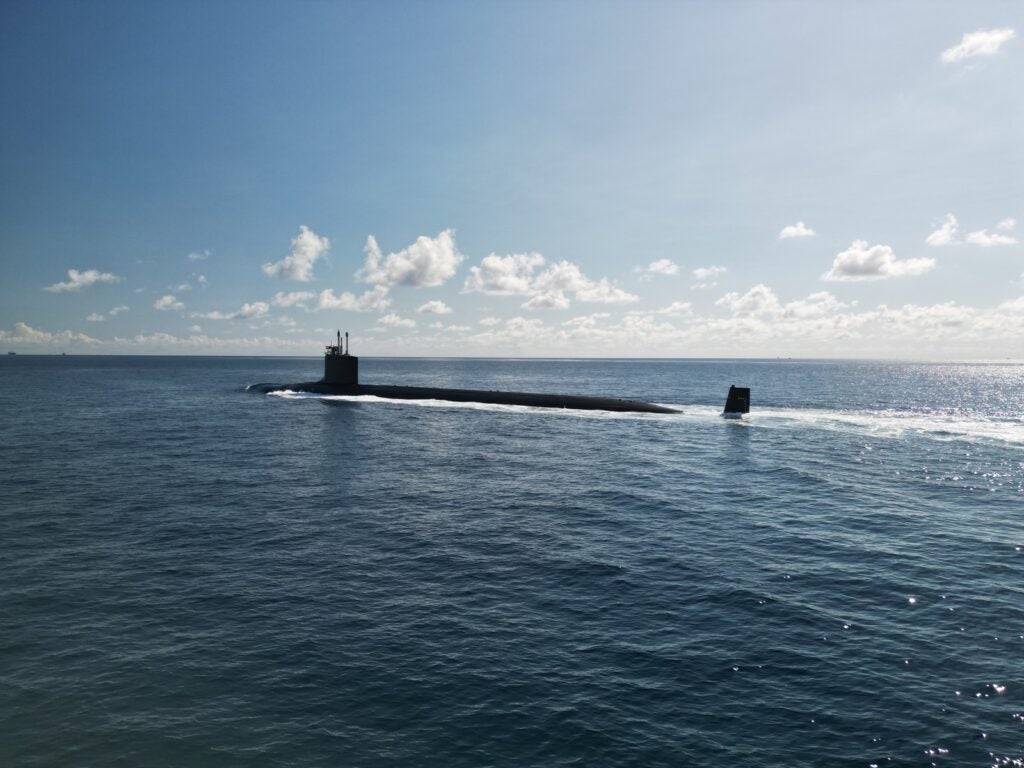
ARLINGTON, Va. – The Virginia-class (SSN-774) submarines have unit costs between $3 billion and $4.5 billion, but the U.S. Navy wants the future SSN(X) boats to be cheaper despite their envisioned higher payloads carrying unmanned vehicles and weapons.
“We’re still in the early time right now. We’ve set the baseline requirements where we know the big rocks, and we know it’s gotta be affordable,” Rear Adm. Andrew Miller, the Navy’s director of undersea warfare, told Exchange Monitor affiliate Defense Daily after his address to the Naval Submarine League’s annual symposium last week. “You can’t have a submarine that can do 40 knots and have 75 torpedoes because it’s gotta be affordable. We have to be able to buy it.”
The Virginia-class have a top “flank speed” of more than 25 knots, and Miller said that the Navy wants SSN(X)’s maximum speed to be higher than the Virginia-class, yet how much higher is to be determined, as each knot of increased speed adds considerable cost.
The Virginia-class “will remain the backbone of our attack fleet for decades, but as adversary capabilities evolve, it requires expanded payload capacity, greater electrical and hydrodynamic margins, and unprecedented architectural flexibility that simply cannot be back-fitted into an existing hull,” Miller told symposium attendees Nov. 12.
The Navy’s undersea warfare division “has been laser focused on one question–what differentiated value must SSN(X) deliver beyond Virginia?” he said. “These priorities lock in five key differentiated capabilities for our future attack submarine. First, higher flank speed and tactical control speed. Two, improved operational availability. Three, decisive lethality. Four, superior stealth and layered survivability; and finally, organic, robotic, and autonomous systems subject to command and control.”
Navy plans for SSN(X) comprise the latest features of new Virginia-class submarines, including the larger missile complement starting in the Block V Virginia boats that have a Virginia Payload Module. The new mid-body Virginia Payload Module is to increase the SSN’s maximum weapons load from 37 to 65.
The Navy is examining whether it will be able to expand its submarine prime contractor base beyond General Dynamics‘ Electric Boat and Huntington Ingalls Industries’ Newport News Shipbuilding.
“Today, roughly 10% of our shipbuilding and manufacturing work is performed at distributed sites outside the traditional yards,” Miller said on Thursday. “Our goal is to support driving that higher.”
“From automated precision manufacturing facilities in Alabama to specialized component repair centers in Ohio, we are working with other stakeholders to invest across the supplier base in more than 16,000 companies in all 50 states,” he said. “This builds resilient, dual source production lines and eliminates single points of failure.”
Electric Boat and Newport News Shipbuilding have said that they are accelerating the outsourcing of submarine module construction. Austal USA has a Mobile, Ala., facility that in recent years has taken on an increasing amount of module manufacturing work for the submarine primes.
Exchange Monitor affiliate Defense Daily first published a version of this story.