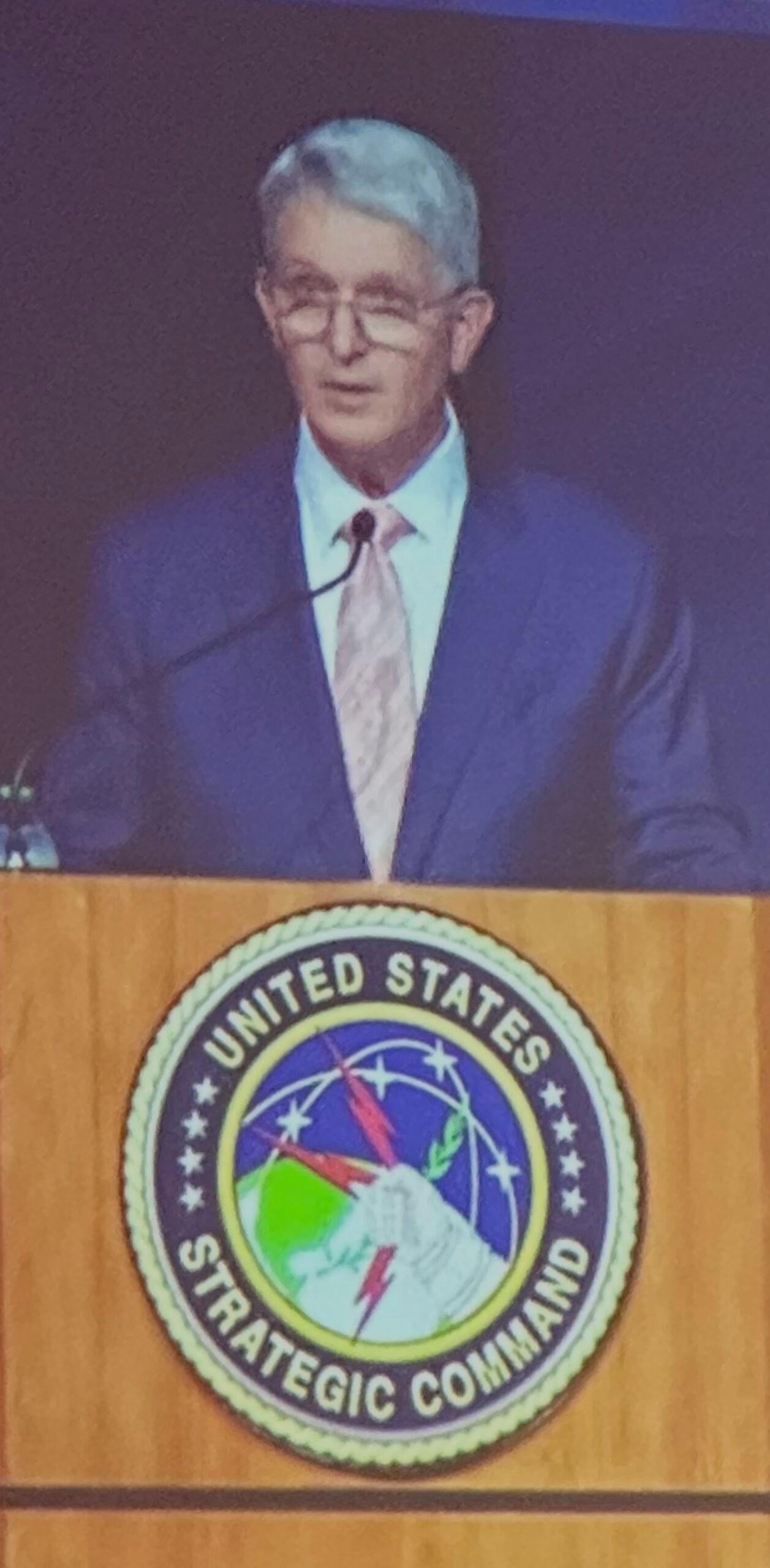
Nearly a year into his tenure leading the National Nuclear Security Administration, Brandon Williams says some of his most difficult decisions have involved challenging the way the agency has traditionally done business.
“The hardest decisions are that we’re not going to do business as usual,” Williams told Exchange Monitor in an exclusive interview in August.
Williams cited the rebidding of the Savannah River plutonium pit production contract and the decision to pursue commercial partners for the lithium mission as two examples of his effort to depart from NNSA’s traditional approach to major projects.
The decisions are significant not only because of the programs involved, but because of what they represent for an agency undertaking the largest expansion of its nuclear weapons enterprise since the end of the Cold War. “They come with a lot of risk,” Williams said. “There’s a lot of resistance.”
Williams’ approach reflects his view that NNSA cannot meet the demands of the current strategic environment by relying on the same processes used in the past.
“We, in many ways, slept for almost 30 years,” Williams said, referring to the period after the Cold War. The United States halted much of its nuclear weapons modernization following the dissolution of the Soviet Union and the end of Communist control in Eastern Europe.
The United States had hoped other nuclear powers would similarly slow the development of their arsenals, Williams said. Instead, Russia, China and North Korea continued advancing their nuclear capabilities, while proliferation threats from countries such as Iran added another challenge.
“[Slowing down] was the opposite of what happened,” Williams said. “Particularly with China.”
For Williams, that history has created an imperative not simply to expand NNSA’s nuclear weapons programs, but to reconsider how the agency executes them.
“NNSA is a production organization,” Williams said. “NNSA has always been a production organization all the way back to the Manhattan Project.”
After the Cold War, the demands of stockpile stewardship shifted much of the enterprise toward maintaining the existing arsenal and developing the science needed to understand aging weapons without nuclear testing. Williams said that scientific work was essential and laid the foundation for many of NNSA’s capabilities today. But it also came “at the expense of production.”
His effort to restore production as a central focus, an effort he’s emphasized since his first public speaking appearance as the agency’s administrator, comes as NNSA works through a sweeping expansion of its nuclear weapons enterprise, including efforts to increase plutonium pit production, modernize warheads and rebuild industrial capabilities that were allowed to contract after the Cold War.
Recent production milestones, including work on the B61-12, B61-13 and W88 programs, have given Williams evidence that the shift is beginning to take hold. At Y-12 National Security Complex, the agency is moving toward completion of B61-13 components, an effort Williams has cited as an example of what the renewed emphasis on production can deliver.
But Williams said production is only one piece of the culture he is trying to establish. “Starting with deterrence really inspires people,” he said. “Urgency, because our times have changed.”
That urgency, Williams said, is intended to give workers a clear understanding of why the agency’s expanding workload matters. The challenge is then turning that sense of mission into actual production — a task that depends heavily on the specialized workforce spread across NNSA’s laboratories, plants and sites.
Williams said NNSA has fewer than 2,000 federal employees but more than 68,000 contractor employees supporting its mission. Recruiting and retaining workers with expertise ranging from nuclear physics and metallurgy to welding, machining and explosives is therefore critical to his strategy. He believes NNSA has an advantage that few other government organizations can offer.
“There’s a tremendous cool factor working at NNSA,” Williams said. Workers get to operate scientific instruments and work with specialized materials and technologies that are unavailable almost anywhere else, he said. But the larger draw is the mission itself.
Williams described visiting the Pantex Plant and watching employees involved in assembling nuclear weapons, where workers have developed highly specialized skills over decades. “They have incredible pride in what they’re doing for the nation,” he said.
That sense of mission is particularly important as NNSA attempts to expand production while preserving the discipline required by the nuclear weapons enterprise.
The approach is also shaped by Williams’s own path to the administrator’s office. Williams served as a Navy nuclear officer and received technical training as a nuclear engineer before moving into business and eventually serving in Congress. A Republican, he represented New York’s 22nd congressional district. He sees that combination of technical and political experience as particularly useful in running an agency whose work can be difficult to explain outside its specialized community.
“NNSA is really good at talking to ourselves,” Williams said. One of his roles, he said, is translating the work of the agency’s scientists, engineers and production workers for the White House, Congress and the American public.
That experience in Congress also taught Williams how to communicate complex issues to people who do not necessarily have technical backgrounds — a skill he considers increasingly important as NNSA’s mission grows.
The agency is now being asked to undertake an extraordinary range of work: modernizing the nuclear stockpile, rebuilding production capacity, supporting nonproliferation efforts, advancing nuclear propulsion and maintaining the scientific infrastructure needed to underpin the deterrent. “The scope and depth and consequence that NNSA is responsible for is really breathtaking,” Williams said.
That breadth has also changed Williams’s own understanding of the job. He said that when he arrived, he quickly realized that no single person could understand every aspect of NNSA’s mission. Touring the laboratories, plants and sites only reinforced his appreciation for the people responsible for carrying out work that is often highly classified and largely invisible to the public.
The lesson, Williams said, has been humility — and dependence on the expertise of the workforce.