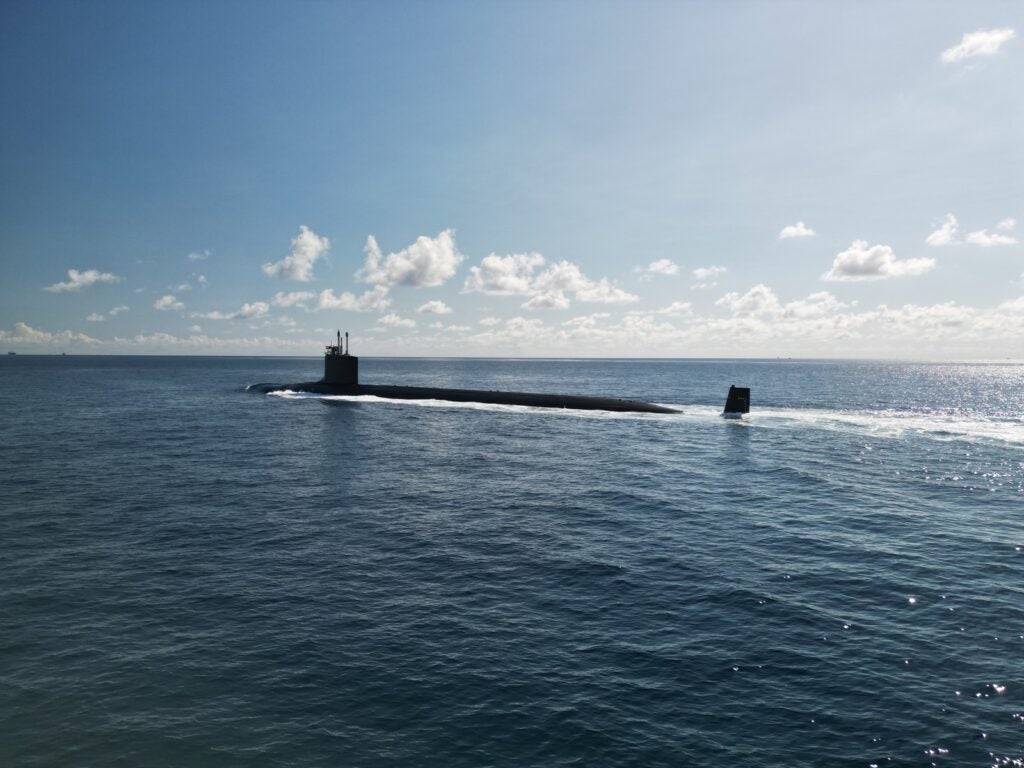
Two Democratic leaders on the House Armed Services Committee on Thursday revealed the Navy did not notify Congress of an October grounding incident with an attack submarine that led to the boat’s three leaders, or command triad, being relieved of their duties.
Submarine grounding occurs, usually unintentionally, when the vessel makes contact with either the ocean floor, a seabed or an underwater obstacle.
The incident was first revealed in a Nov. 10 article published by the local southeastern Connecticut newspaper, The Day.
According to the report, Cmdr. Dan Goodwin was relieved from his post as commanding officer of the USS South Dakota (SSN-790) on Oct. 14, with confirmation from the Navy and comments that he was relieved “due to a loss of confidence in his ability to fulfill his assigned duties.”
Beyond Goodwin, a command triad consists of the executive officer and chief of the boat.
Goodwin took command of SSN-790 on June 30, according to a Navy press release at the time. Goodwin previously served a tour at the PMS-351 New Attack Submarine program office. The South Dakota was commissioned in Feb. 2019.
In a letter to acting Secretary of the Navy Hung Cao, whose nomination hearing was this week, and Chief of Naval Operations Adm. Daryl Caudle released on Thursday, Reps. Joe Courtney (D-Conn.), ranking member of the House Armed Services Committee seapower and projection forces subcommittee, and Adam Smith (D-Wash.), ranking member of the full committee, said the Navy has not previously disclosed the incident to Congress and demanded information on the event.
“Though nearly a month after the relief of the command triad, no notifications of the personnel actions or the underlying incident had been made to the House Armed Services Committee. On Nov. 12, 2026, an article was published on the incident, including confirmation from the public affairs office for Commander, Submarine Force Atlantic,” Courtney and Smith wrote.
These members, set to become chairman of the seapower subcommittee and full committee in January, respectively, following this month’s election, called the Navy’s failure to communicate the activities to Congress “unacceptable.”
“The committee and Department maintain long-standing customs for information sharing, that though not expressly written in statute, have included notifications for various types of at-sea incidents, accidents, and dismissals of members of the command triad.”
Courtney and Smith said timely communication with Congress on these kinds of incidents is especially important following collision and grounding incidents over the last two decades involving the Arleigh Burke-class USS Fitzgerald (DDG-62) and John S. McCain (DDG 56) destroyers as well as the Los Angeles-class USS Hartford (SSN-768) and Seawolf-class USS Connecticut (SSN-22) attack submarines.
They wrote that after those incidents “clear and timely communication with Congress was necessary to make informed decisions to ensure personnel safety and readiness of the fleet. Even after these events, Congress relied on continued good-faith communication with the Department, as opposed to codifying notification requirements.”
“Failing to provide timely notifications to Congress is counterproductive to good policymaking and undermines the Department’s stated goals of transparency and accountability and put leadership judgement into question,” they added.
As of Thursday, Courtney and Smith said the Navy has still not provided the committee with any official notification of the details of the commanding officer’s dismissal so they do not know what occurred, any impact on the structure of SSN-790, crew impacts and if the event revealed systemic issues with training.
They said due to the Navy’s failure to communicate with Congress, a standard of information sharing now “raised questions about the Navy’s commitment to transparency and its commitment to a productive working relationship with Congress.”
The lawmakers requested the top two Navy leaders answer a series of questions by Nov. 20, including what led up to the command triad’s relief, was dismissal caused by grounding or another mishap at sea, what is the estimated cost of damages, any structural damage details, estimated timeline to repair any damage, and why they decided not to notify Congress.
Exchange Monitor affiliate Defense Daily first published a version of this story.