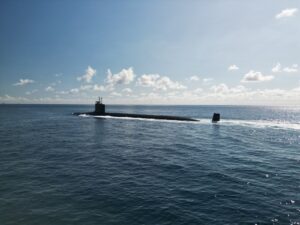
President Donald Trump last week announced South Korea will build a nuclear-powered submarine in Philadelphia, with the U.S. sharing sensitive technology with South Korea akin to the AUKUS agreement.
“South Korea will be building its Nuclear Powered Submarine in the Philadelphia Shipyards, right here in the good ol’ U.S.A. Shipbuilding in our Country will soon be making a BIG COMEBACK. Stay tuned!!!” Trump said in a Truth Social post last Wednesday night Oct. 29 following a meeting with South Korean President Lee Jae Myung.
South Korean conglomerate Hanwha bought the Philly Shipyard for $100 million at the end of 2024. Hanwha Philly Shipyard CEO David Kim told reporters earlier this year the parent company plans to invest multiple times its buying cost to upgrade the shipyard’s production capacity from the current level of under two vessels per year to six to 10 ships per year or more than 10 in less than 10 years.
At the time, Kim said shipyard ownership hoped to produce liquefied natural gas tankers and shift into bidding on U.S. Navy auxiliary ships and modules for combat vessels, akin to Austal USA building modules for Virginia-class nuclear-powered attack submarines (SSNs). He hoped they would ultimately move up to bidding on full Navy combat ships.
If Trump’s statements on the Philly Shipyard building South Korean SSNs holds true, that would require another major modification to the facility.
The U.S. government has already been pushing billions of dollars into the submarine industrial base to boost the workforce and production capability up to two SSNs per year and ultimately 2.33 per year, to make up for at least three Virginia-class submarines the U.S. plans to sell to Australia under the AUKUS agreement. Hanwha would face the same issues in attracting a large enough workforce to produce SSNs for South Korea.
The Australia-United Kingdom-U.S. (AUKUS) agreement also required significant changes to export controls to make it possible for Australia to create an SSN maintenance and construction business to manage naval nuclear propulsion. In that case Australia will still not be directly producing the nuclear reactors in the future SSN-AUKUS submarines.
It is also unclear if these new Korean submarines will have the nuclear reactor constructed in South Korea or the U.S. According to news reports, South Korea previously pitched the Biden administration on gaining access to nuclear propulsion technology.
Dr. Duyeon Kim, an adjunct senior fellow at the Center for New American Security, called this huge news, but a lot depends on whose reactor and fuel are going inside the South Korean SSNs. Kim also noted the 123 Agreements would need to be revised in any case because the components in the submarines are for military purposes, even if not for nuclear weapons.
The 123 Agreements are international nuclear cooperation agreements for significant transfers of nuclear materials or equipment from the U.S. based on Section 123 of the U.S. Atomic Energy Act.
Exchange Monitor affiliate Defense Daily first published this story.