New Global Nuclear Headquarters connects commercial and government expertise across 12 countries
Oak Ridge has come a long way from its beginnings as the Secret City. Its emergence as an epicenter of today’s nuclear renaissance made it a natural choice for Amentum’s new Global Nuclear Headquarters. The facility, which opened Oct. 8, brings together the company’s global nuclear capabilities as demand accelerates in the United States and around the world.
The headquarters houses Amentum’s Nuclear Center of Excellence and more than 150 subject-matter experts. The Center serves as the central point for a nuclear business spanning 70 projects in 12 countries, connecting Amentum’s operational and technology hubs so capabilities developed on one project can be deployed on another.
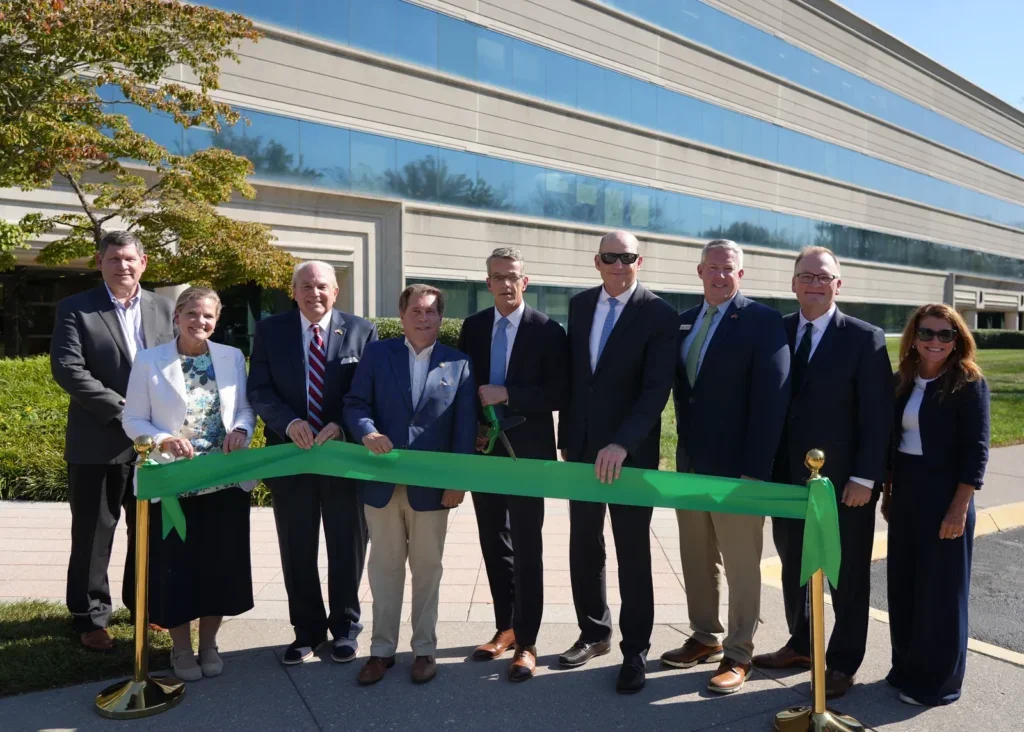
Amentum began reorganizing its nuclear business around the Center before the new headquarters opened, a move designed to bring greater consistency to its international portfolio.
“Clients get consistent, repeatable application of our technologies, and we are not recreating the wheel on every new project,” said Mark Whitney, president of Amentum’s Energy & Environment division.
The decision to base that operation in Oak Ridge reflects both Amentum’s history in the region and what the company sees ahead. Amentum leads United Cleanup Oak Ridge (UCOR), the Department of Energy’s (DOE’s) prime environmental management contractor for the Oak Ridge Reservation, and has supported government nuclear work in the region for decades. At the same time, the company estimates approximately $25 billion in announced commercial nuclear investment in the Oak Ridge area.
“As a leader in this space, we wanted to be here, in a community that is fully behind the nuclear resurgence,” Whitney said.
Amentum’s analysis also points to more than $125 billion in global nuclear capacity spending over the next decade. By executive order, the Trump administration has set a goal of quadrupling U.S. nuclear capacity, from roughly 100 GW in 2024 to 400 GW by 2050.
Reaching that goal will require a different approach to nuclear construction. Vogtle Units 3 and 4, completed in 2023 and 2024, were the first new U.S. nuclear reactors in more than three decades.
“With Vogtle, we were rebuilding the supply chain and doing things we hadn’t done in decades,” Whitney said. “The way to succeed now is through repetition. You build these projects again and again.”
That kind of sustained nuclear development is already underway in markets where Amentum is a leading force in nuclear energy. Its portfolio includes delivery roles at every U.K. nuclear power station built. Current projects include Hinkley Point C and Sizewell C in England, and the global program delivery partner for Rolls-Royce Small Modular Reactors (SMRs). In Poland, Amentum is working as owner’s engineer for the country’s AP1000 new-build program and on the SMR program in Czechia. In the Netherlands, the company is operating the technical management organization for its nuclear new-build program and played a significant role in the United Arab Emirates new build completed two years ago at Barakah.
The company also operates the U.K.’s largest private-sector complex of nuclear laboratories and engineering test facilities. In the U.S., Amentum has agreements with Westinghouse to support fleet-scale deployment of the AP1000 reactor and development of the AP300 SMR.
Behind Amentum’s international and U.S. project work is a nuclear portfolio supported by more than 9,000 employees. Through the Center of Excellence, that expertise can be deployed across projects and geographies.
“We now have the ability to provide a global, integrated project delivery platform in nuclear, no matter where in the world the work is,” Whitney said.
That integrated approach extends across government and commercial nuclear work as well. Whitney pointed to growing demand from the National Nuclear Security Administration (NNSA), including new energy and infrastructure needs tied to advanced nuclear and AI. Many of the engineering and project-delivery capabilities required for that work overlap with the commercial market.
“The same people who design, license and deliver commercial nuclear facilities also support our DOE and NNSA customers,” he said.
For Whitney, the current momentum in nuclear represents an unusual moment for the industry. “I have never seen this many things come together at the same time: broad political support, public backing and, most importantly, need.”
Even with those conditions in place, significant challenges remain. Nuclear build requires a multifaceted approach, connecting power users, land, technology, supply chain and funding. Capital that has been difficult to secure is becoming more available through federal support, international investment and growing interest from hyperscalers. Amentum is ideally placed to help integrate these interconnected elements and speed the path to nuclear energy deployment. The harder constraint may be finding enough people to deliver the projects.
“Skilled labor and the workforce to build all of this is perhaps the biggest challenge we have,” Whitney said.
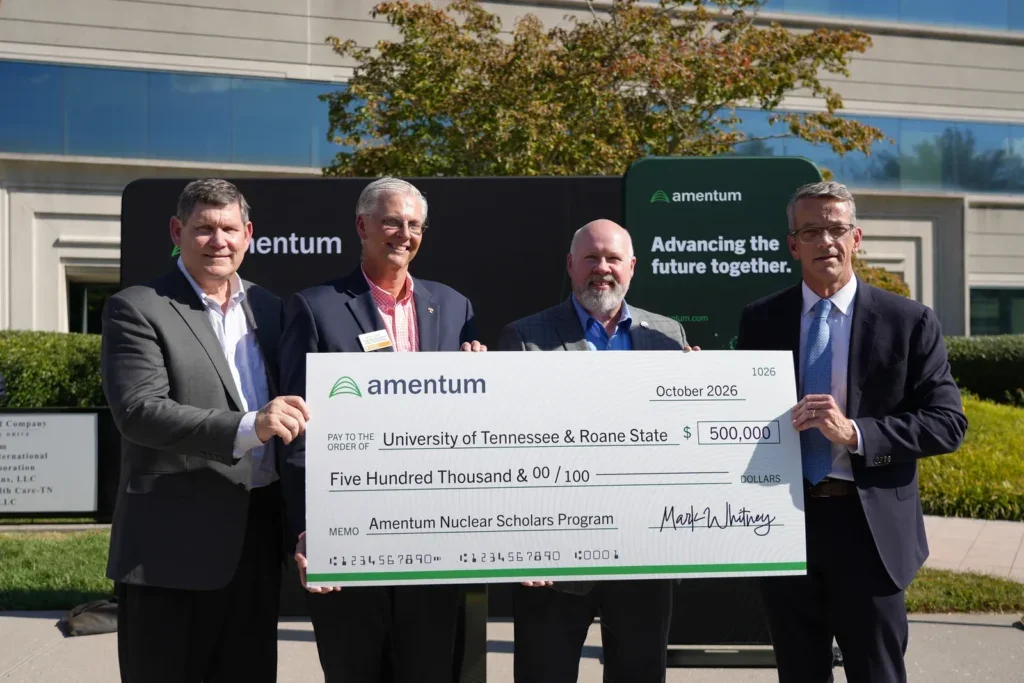
Amentum is addressing that challenge through the Amentum Nuclear Scholars Program, launched alongside the headquarters in partnership with Roane State Community College and the University of Tennessee, Knoxville (UTK). The company is investing $500,000 over five years in curriculum development and scholarships. Combined with other Amentum-led STEM sponsorships and donations in the Oak Ridge community, student support for the two institutions exceeds $1 million. The first U.S. cohort begins in late 2026, with plans to expand the program internationally in fall 2027.
“Many students grow up near nuclear sites without knowing the careers that exist around them, so we want to reach them early and give them a clear path from the classroom to a career,” Whitney said.
That pathway begins with STEM outreach in middle school and Oak Ridge High School’s nuclear track. Students can then earn an applied science degree at Roane State through Tennessee Promise, continue into engineering at UTK and pursue internships with Amentum or UCOR, with opportunities extending to Amentum operations overseas. The company has used a similar internship-to-hire approach at other sites, and UCOR also supports a nuclear engineering program at Tennessee Tech.
“This partnership paves the way for students to gain the educational foundation necessary to excel as future leaders in the nuclear industry. Through the financial support from Amentum and practical internship experiences, our engineering students will be prepared to step directly into high-demand roles that will positively impact our community, state and country,” said Matthew Mench, dean of UTK’s Tickle College of Engineering.
Roane State provides another entry point to that pathway. “By partnering with Amentum, we are opening doors for students to start right here in their community and graduate onto a global stage. The Amentum Nuclear Scholars Program removes the financial hurdles that often halt a student’s momentum, providing a direct, supported pathway from our classrooms straight into high-wage, high-impact careers,” said Dr. Chris Whaley, president of Roane State Community College.
Developing the workforce will be critical to turning the nation’s nuclear ambitions into reality. So will having the technology, expertise and proven approaches to project delivery in place. For Whitney, the experience gained in nuclear markets around the world offers a measure of what is possible.
“We know this can be done because we are seeing it happen in other countries,” Whitney said. “There is no reason we can’t do it here. I am confident we can deliver these projects on schedule, on budget and at the pace needed to meet demand.”