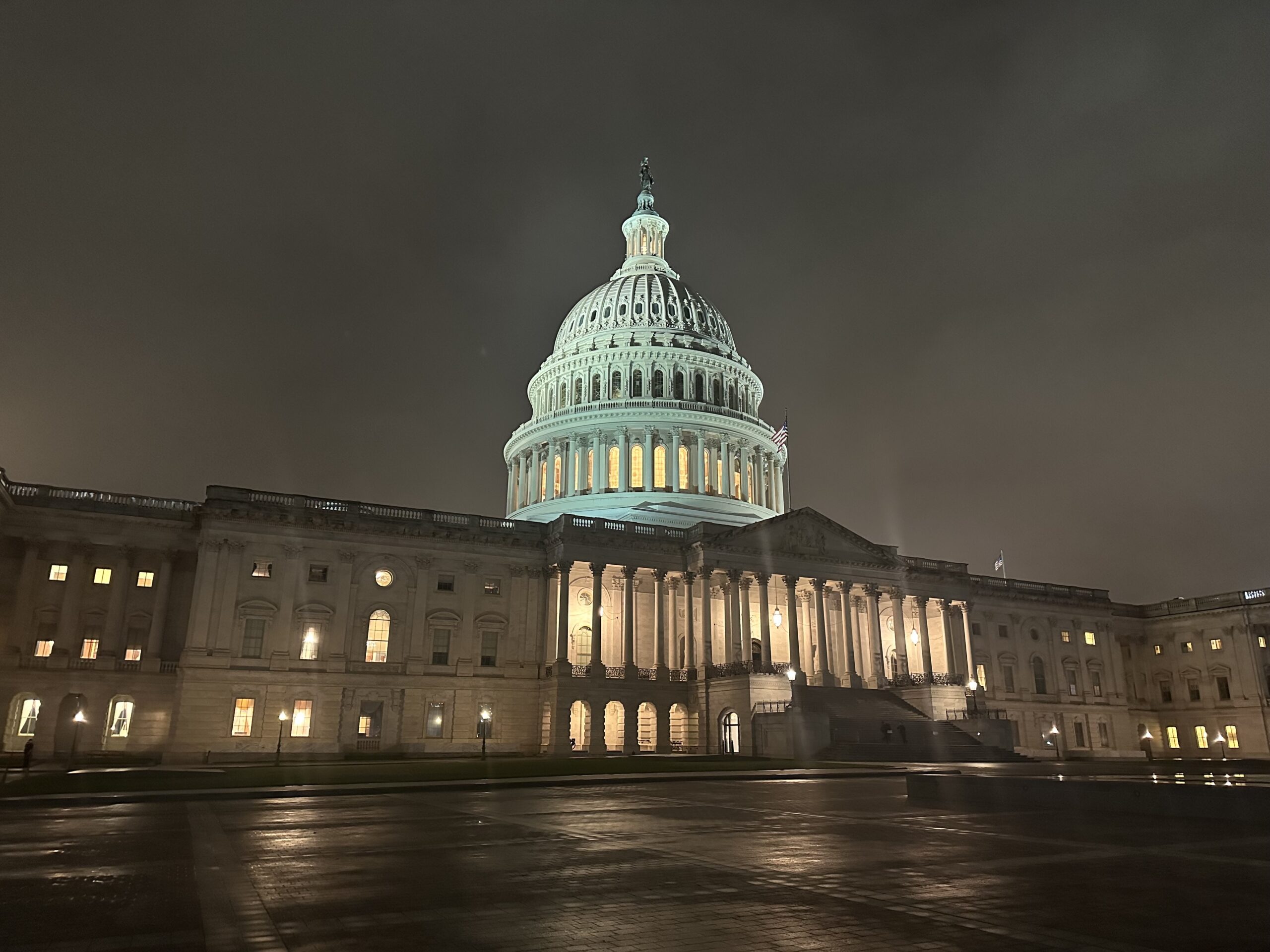
President Donald Trump Thursday signed the $901 billion 2026 National Defense Authorization Act (NDAA) into law that would allow nearly $26 billion in funding to the National Nuclear Security Administration (NNSA).
That is the highest authorization limit yet for the agency in charge of maintaining the nation’s nuclear weapons stockpile, and $100 million more than the Senate would have authorized based on its earlier version. It is also $700 million more than what the White House sought in its 2026 budget request. It is also about $500 million more than what the House would initially authorize.
Trump signed the bill after the Senate and House passed their combined versions of the policy bill. The House last week voted 312 to 112 to advance the bill to the Senate, and the Senate Wednesday, in a 77-20 vote, passed it on to Trump’s desk.
Though the bill had support from both parties, Democratic Senators Ed Markey (Mass.), Elizabeth Warren (Mass.) and Cory Booker (N.J.) voted against the legislation. Republican Senators Mike Lee (Utah) and Rand Paul (Ky.) also voted against the bill. Lee is the chairman of the Senate Committee on Energy and Natural Resources.
The annual NDAA, which is not an appropriations bill, sets policy and spending limits for defense agencies, including the NNSA, which is the DOE’s semi-autonomous agency in charge of maintaining the nation’s nuclear weapons stockpile.
“Not since the era of World War II has our nation faced an axis of aggressors across multiple theaters seeking to dismantle American influence,” Senate Armed Services Committee Chairman Roger Wicker (R-Miss) said in a statement after the bill’s passage. “The bill we now send to the president’s desk is a reflection of that reality and an appropriate response.”
Committee ranking member Jack Reed (D-R.I.) said in his corresponding statement the U.S. faces “significant national security challenges, but this NDAA makes meaningful progress toward meeting them.”
The fiscal 2026 NDAA contains $162 billion for procurement, $146 billion for research and development and $34 billion for defense nuclear programs.
For shipbuilding, lawmakers authorized $26 billion that includes covering a third Columbia-class submarine and one Virginia-class submarine.
The conference bill also would authorize just over $21 billion for weapons activities, a little under $1 billion more than the White House sought. It is about $800 million less than the Senate would have authorized and $500 million more than the House would have authorized.
Defense nuclear nonproliferation, a controversial spending topic among House Democrats specifically in the appropriations bills, would be set at $2.2 billion, same as the White House and House would authorize and about half a billion less than the Senate would have authorized.
The bill also said the funds in it could not be used to establish a “cap on reimbursement of compensation and benefits for non-federal employees” either under contract with NNSA, working on nuclear weapons delivery systems at DOD, or working on Golden Dome infrastructure.
In terms of policy, the Senate’s original version of the bill included a provision to classify DOE workers performing “Atomic Energy Defense Activities” as “considered as a position that is necessary to meet national security responsibilities,” protecting DOE workers from layoffs under the Department of Government Efficiency. The conferenced version of the bill said the Secretary of Energy can treat any workers that fall under this category as necessary to fulfill DOE’s national security responsibilities.
The conferenced bill also includes a provision to protect NNSA facilities from unmanned aircraft, or drones.
The bill would also direct the Air Force Secretary and Undersecretary to submit a strategy to the relevant congressional committees “to address aging components and maximize the end-of-life margin” of the ground-based Minuteman III LGM-30G intercontinental ballistic missile (ICBM), which would be replaced eventually by the Sentinel LGM-35A ICBM.
Earlier this month, Sens. John Hoeven (R-N.D.) and Mike Rounds (R-S.D.) said Sentinel would be part of Golden Dome and “moving.” The bill itself said missile defense policy would reflect “Golden Dome for America” policy, and that developing Golden Dome strategy should include “a holistic assessment of the total ground segment requirements to support the architecture” of Golden Dome.