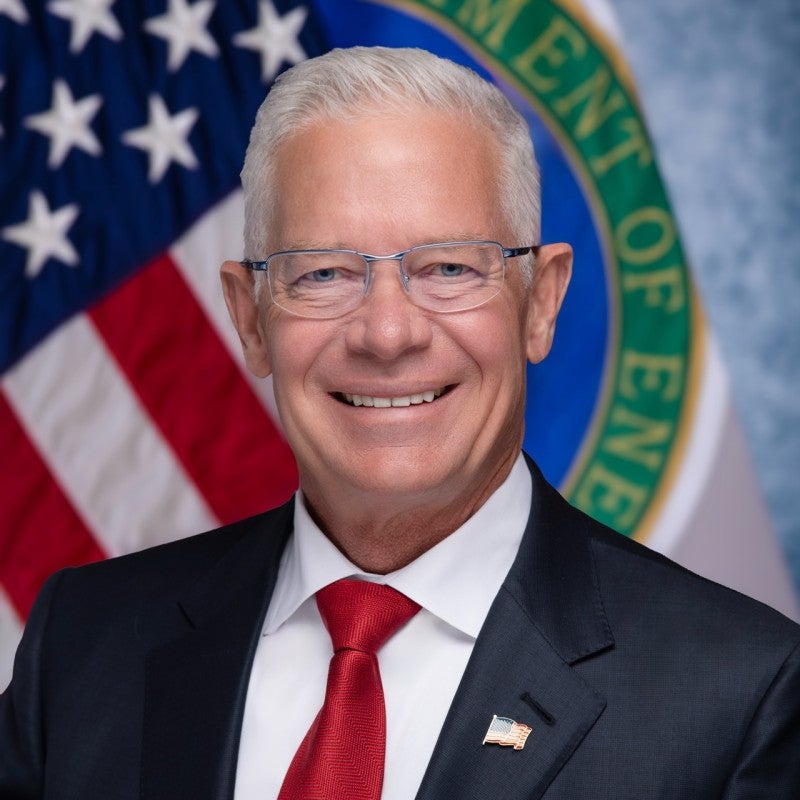
ARLINGTON, VA – The head of the Department of Energy’s $8-billion nuclear cleanup branch said here Tuesday the Office of Environmental Management (EM) is indeed being renamed.
In his “State of EM” speech, Walsh again said the Environmental Management office is being rebranded as the “Office of Nuclear Restoration and Revitalization. His remarks came at the 2026 National Cleanup Workshop.
“Coming from the private sector, I can tell you that branding and having the right name matters,” said Walsh, a former member of the U.S. Army Corps of Engineers that went on to head his own commercial real estate company.
The new name “conveys who we are to others” and to employees, Walsh said. Walsh had first signaled the name change during the Waste Management Symposia during March in Phoenix. He acknowledged the change is taking longer than he expected.
Walsh said the name change would be “formally” implemented soon but did not say when. Walsh drew laughs when he said cleanup of the Hanford Site in Washington state might be done before the new name is implemented.
After the speech, Walsh told Exchange Monitor that inspiration of the new name dates back to 1989 when Environmental Management was formed to remediate nuclear sites with a goal of returning land to local communities for beneficial reuse. “Our core mission remains to clean up our legacy nuclear sites” to protect public health and the environment.
Likewise, Walsh said he is continuing to work on a “regional” reorganization of the nuclear cleanup branch.
The reorganization is in the final stages of being reviewed at DOE headquarters, Walsh said after the speech. It has been a decade since the last EM reorganization, and some sites have been closed since then.
“So there will be a northeast regional focus that will include our Naval reactor sites that we are doing cleanup on, as well as West Valley [in western New York],” Walsh said. There will also, for example, be an East site that “will oversee the cleanup of three of our former gaseous diffusion plants” – Portsmouth, Paducah and Oak Ridge.
Some of the biggest sites, such as Hanford and Savannah River Site, will remain unchanged, Walsh said. A Southwest office could focus on the Waste Isolation Pilot Plant (WIPP) and Los Alamos National Laboratory, both in New Mexico, as well as the final stages of cleanup of Moab. More details will come out in the future.
Since Walsh became DOE assistant secretary for Environmental Management nearly a year ago, new data centers for artificial intelligence (AI) have been announced at the Portsmouth Site in Ohio and other DOE cleanup properties.
“I am proud that EM is leading America’s AI revolution,” Walsh, who has been a DOE point man for data centers for Energy Secretary Chris Wright, said to the crowd.
There has been a lot of “gloom and doom” about AI, Walsh acknowledged. However, if AI becomes powerful enough to endanger humanity, then the United States cannot afford to lag behind China in the AI race, Walsh said.
“Every time the government steps in and regulates we get less of something,” Walsh said, echoing President Donald Trump’s belief AI should not be regulated.
AI data centers are providing communities around DOE sites with a new tax base, Walsh said.
Walsh, like other speakers during the two-day program, said reindustrialization projects are leading to hundreds of billions of dollars being invested in and around DOE nuclear sites for everything from data centers to small modular reactors.
Local officials from the Portsmouth Site and the Paducah Site told Exchange Monitor on the sidelines of the event that project developers are buying land around those DOE properties at well-above market rates.
The projects “are creating opportunities for our communities that they didn’t believe could happen,” said Energy Communities Alliance (ECA) Executive Director Seth Kirshenberg, who kicked off the Cleanup Workshop. “It’s creating a new tax base,” the ECA official said.
The DOE sites have been underutilized assets, Walsh said.
“To date we have announced over $650 billion of private investment at or adjacent to our sites,” Walsh said. The nuclear-related projects will “support President Trump’s goal of increasing nuclear power from 100 gigawatts to to 400 gigawatts by 2050.”