Wrap Up: In the Industry

NS&D Monitor
11/14/2014

IN THE INDUSTRY

Ed Najmola, the construction vice president for Mixed Oxide Fuel Fabrication Facility contractor CB&I AREVA MOX Services, is leaving for a corporate post at CB&I this month. Taking over as acting construction vice president will be Danny Hosey, most recently the contractor’s area project manager for HVAC. Najmola joined MOX in 2010 and the change comes after this month former MOX Services President Kelly Trice also moved to a corporate position. “Ed has done a lot for the MOX project over the past five years, including overseeing many quarters of construction without the NRC citing a violation and ensuring positive labor relations. The MOX Services management team and workforce appreciate Ed’s efforts and we all wish him well in his new endeavors,” MOX Services President David Del Vecchio said in a statement. Hosey has been with MOX since 2003.

Glenn Morgan of Huntington Ingalls Industries has been promoted to vice president of nuclear materials operations and will serve as Savannah River Nuclear Solutions’ deputy director of EM operations, Huntington Ingalls announced last week. He takes over for Steve Howell, who is now SRNS director of strategic initiatives. Morgan was previously director of reactor services engineering at Newport News Shipbuilding, and will now be responsible for the M&O contractor’s projects at H-Canyon including plutonium oxide production and spent fuel processing and disposition and oversee SRNS’ environmental management operations. SRNS is a partnership between Fluor, Honeywell and Huntington Ingalls’ Newport News Shipbuilding division.

In This Issue


More on This Topic


Fusion company inks deal with Hanford area economic development group

Seattle-based Avalanche Energy Designs, a fusion energy developer, signed an agreement last week with the Tri-City Development Council to cooperate on building a plant capable of manufacturing fusion power devices in Richland, Wash.

 Richland is nestled next to the Department of Energy’s sprawling Hanford Site.

 A big hurdle with fusion is that the power produced can be less than the power going into the device. Right now, there are dozens of fusion development projects using different technologies, according to the Department of Homeland Security. No commercially viable fusion reactors are currently producing electricity.

 Avalanche believes it is on track to solve that problem with its technology by 2030. Avalanche wants to build fusion devices of between 100 kilowatts and 5 megawatt at its future Richland plant to sell around the world.

 The actual site in Richland has not been nailed down yet.                                                                                                     

Avalanche already has a subsidiary, FusionWERX, in northern Richland. FusionWERX tests equipment that the company is developing for its fusion technology.

 Avalanche picked the Tri-Cities because of its huge population of nuclear and energy scientists, engineers and technicians. Northern Richland is also home to the Pacific Northwest National Laboratory and the Washington State University’s Tri-Cities campus. S

In This Issue

More on This Topic


DOE, ABS MOU explores nuclear technology for commercial maritime uses

The Department of Energy’s Office of Nuclear Energy and the American Bureau of Shipping (ABS) signed a memorandum of understanding (MOU) Monday to collaborate on using advanced nuclear technology for maritime purposes. 

According to ABS’ press release, the MOU explores technologies ranging from “floating power solutions, nuclear-powered vessels and the development of the ports, shipyards and industrial base needed to build and sustain them.” These ventures will be explored through concept and feasibility studies, ABS said.

ABS will also coordinate related work through the Maritime Administration’s U.S. Center for Maritime Innovation. ABS serves as the secretariat for the center.

DOE will be the leading government agency for maritime nuclear use, according to the release. Within the MOU, ABS will work with the Maritime Nuclear Applications Group and will supply technical, economic and regulatory assistance as well as feasibility studies.

The Maritime Nuclear Applications Group already works with DOE’s National Reactor Innovation Center to integrate nuclear technologies for maritime use.

“Advanced nuclear technology has the potential to transform the commercial maritime industry and open new markets for American innovation,” Assistant Secretary for Nuclear Energy Ted Garrish said in the release. “The Department of Energy’s partnership with the American Bureau of Shipping will help explore how we can build on decades of experience to safely bring next-generation nuclear technologies to the maritime sector and position America to lead this emerging industry.”

In This Issue

More on This Topic


Army’s Janus program potential support for broader ‘Fortress America’ energy push

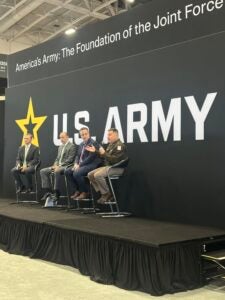
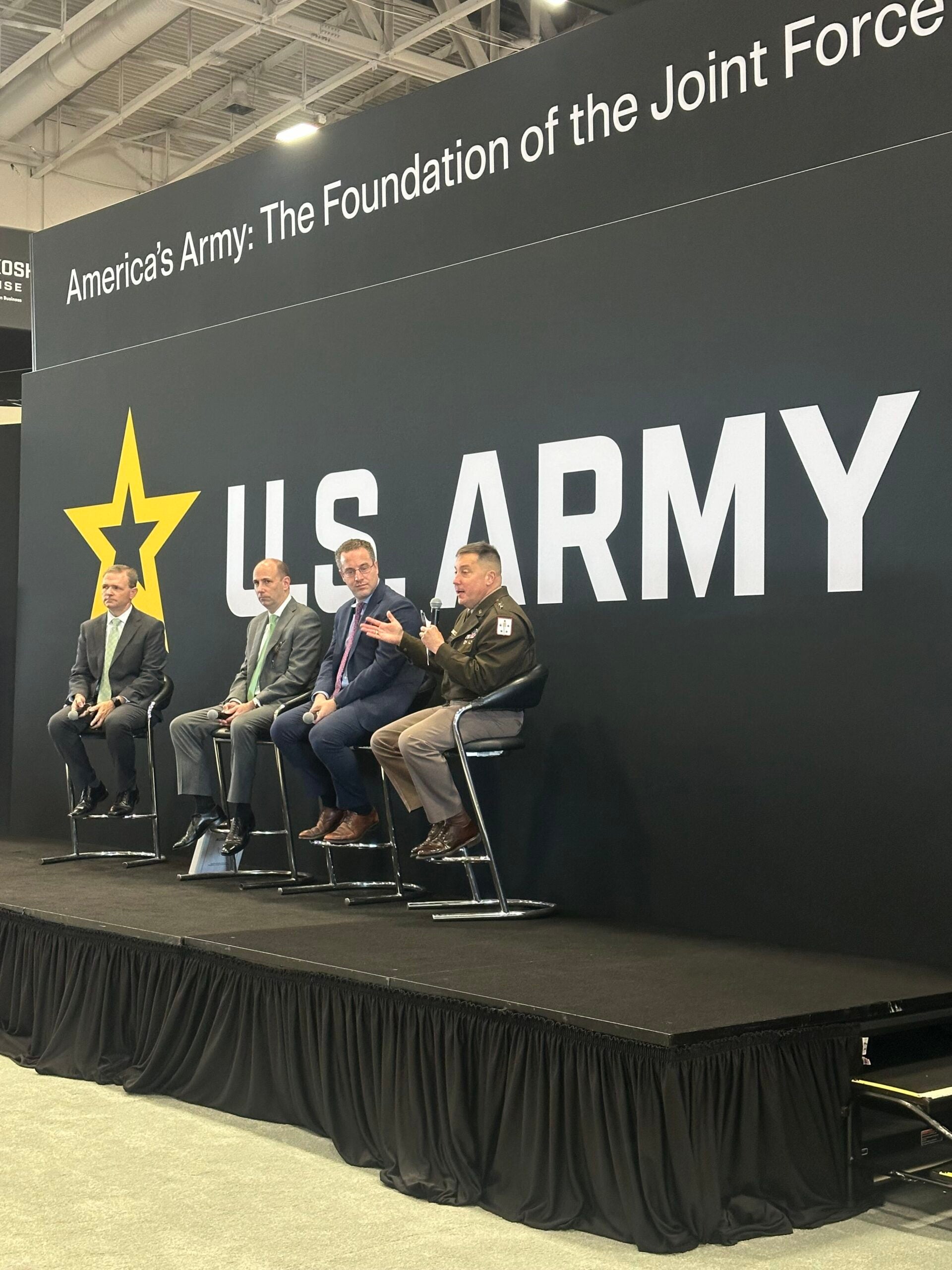
WASHINGTON, D.C. – The Army’s Janus nuclear power program could support the military’s broader energy resilience goals under the Donald Trump administration’s “Fortress America” initiative, though officials said the effort will encompass multiple energy technologies.

“Fortress America” – which stands for Federal Operations for Resilience, Troop Resources, Energy, Supply and Survivability – is a national defense initiative launched by Defense Secretary Pete Hegseth on Sept. 30. One of the main pillars mandated each major military installation generates power independently, without specifying what kind of power.

Army officials, in comments at the Association of the U.S. Army’s (AUSA) annual conference here Tuesday, said the service is pursuing an all-of-the-above approach to installation energy, including nuclear power, natural gas, solar and battery storage, as it seeks to ensure reliable electricity for military operations.

“It’s not Janus in particular,” Principal Deputy Assistant Army Secretary for Installations, Energy and Environment Jeff Waksam said in response to a question by Exchange Monitor on the connection to Fortress America. “It’s really whatever energy that we can use.”

The comments suggest Janus will contribute to the broader effort to strengthen installations’ energy resilience, but nuclear power will be one component rather than the sole focus. “So it’ll be some nuclear, but also gas and solar batteries, whatever it is at each installation that’ll get us the power projection we need,” Waksam continued. “We’re focused on energy resiliency, however it can be.”

“We’re looking for all of the above,” Assistant Army Secretary of Installations, Energy and Environment Jordan Gillis concurred on the same panel. “Especially from the energy side.”

Under the Janus program, a joint effort between the Army and Department of Energy announced at last year’s AUSA conference, the Army is moving toward a commercially owned-and-operated model for nuclear power facilities, with private companies expected to lease land, build reactors and operate them under Army oversight.

Waksam and Gillis said the commercial model is intended to leverage private-sector capabilities while maintaining government control over safety and operations. The timing of Janus will also intersect with broader installation energy projects, and Gillis said current energy initiatives support Fortress America, while Janus facilities are expected to come online later, “a couple of years from now.”

In This Issue

More on This Topic


DOE employee faces prosecution for helping terror group; Hanford not targeted

Ashton Hamed Ellaboudy, a Department of Energy employee at the Hanford Site in Richland, Wash., was to appear in federal court Thursday in connection with Justice Department allegations that he aided a foreign terror group, according to news first reported in the Tri-City Herald.

Ellaboudy is in the Benton County jail after being arrested on Thursday Oct. 1, according to the Oct. 5 newspaper article. He was originally scheduled to appear in federal court Tuesday but that was pushed back until Thursday to provide time for the defendant to find legal representation.

Ellaboudy has too much income to qualify for a court-appointed lawyer, according to the article, citing a finding last week by a federal magistrate. 

A search in LinkedIn found an Ashton Ellaboudy in the Kennewick, Wash., area, listed as employed by DOE in the nuclear safety division at Hanford since April 2023. 

“The Hanford Field Office appreciates the leadership and diligence of the investigation conducted by the FBI,” said DOE’s Hanford Field Office Manager Ray Geimer in an Oct. 1 press release from the U.S. Attorney’s office in Eastern Washington state.

“This matter did not involve an attempt to harm the Hanford Site or its workforce, and at no time was there a threat to the safety or security of the site,” Geimer added in the release. “We remain committed to providing a safe and secure workplace as we move the Hanford mission forward.” 

A DOE spokesperson at Hanford directed any further request for comment on the individual and his employment at the department to DOE headquarters in Washington, D.C.

Other than saying Ellaboudy was a federal DOE worker at Hanford, a DOE spokesperson at headquarters directed any further press inquiries to the Justice Department. 

Ellaboudy, age 51, could face 20 years in prison if convicted of aiding the Houthis, according to the U.S. Attorney’s office. 

“As alleged, a U.S. government employee traveled overseas and used his specialized expertise in an attempt to aid the Houthis, a designated Foreign Terrorist Organization backed by Iran,” said Assistant Attorney General for National Security John Eisenberg, in the press release. “Additionally, Ellaboudy acquired materials for the construction of explosive material and drones capable of delivering these explosives. These allegations are so deeply disturbing that they almost defy imagination.”

According to the federal press release, Ellaboudy got the FBI’s attention when he started buying “precursee” chemicals and materials that can be used in homemade explosives. He also started ordering parts that could be used to build drones. 

During the course of the investigation, Ellaboudy “began communicating with an FBI confidential human source” who claimed to be in touch with a Houthi “colonel,” according to the federal press release. Ellaboudy sought to use his expertise to help the Houthis set up solar power and communications equipment. 

Citing Justice Department documents, the newspaper said Ellaboudy is a naturalized U.S. citizen with family ties to Egypt. The newspaper reported Ellaboudy traveled to Yeman in September 2025 without authorization. Yeman’s capital is controlled by the Iran-backed Houthis, which the U.S. government has dubbed a terrorist organization.

According to the Herald article, upon returning to the United States, Ellaboudy told officers at Los Angeles International Airport he was traveling for DOE to inspect missile sites. Citing court papers, the newspaper said his DOE boss said his federal job did not involve foreign travel.

The FBI’s Inland Northwest Joint Terrorism Task Force investigated the case. The prosecution is being handled by the Assistant U.S. Attorney Lisa Cartier-Giroux for the Eastern District of Washington and trial attorneys Patrick Cashman and Ryan White of the Justice Department’s National Security Division’s Counterterrorism Section. 

More on This Topic


Anduril will start new Baltimore shipyard with $3.7 billion investment

Anduril Industries and the White House Tuesday announced plans for a new 2 million square foot shipbuilding facility in Maryland that will focus on producing Virginia-class attack submarine (SSN) parts.

The new facility, built with a combined $6.6 billion in private capital investment and federal contracting, will be called Arsenal-2 as a nod to Anduril’s first large manufacturing campus, Arsenal-1 in Pickaway County, Ohio. Arsenal-2 will be in the Sparrows Point complex at the Tradepoint Atlantic site in Baltimore County, Md. 

Anduril said it expects the project to ultimately 3,100 direct jobs and support another 11,000 indirect jobs and drive $2 billion in annual economic output, including an estimated $312 million in wages annually.

The company said permitting and site preparation will start immediately and construction will start as soon as they can, pending necessary approvals. It said initial operations at Arsenal-2 are expected to come online in 2030, with production “scaling progressively thereafter as Anduril builds the workforce, supplier base, infrastructure, and manufacturing throughput required for submarine production.”

Anduril said the new facility is backed by a $3.7 billion private capital investment from the company while announcing the Navy also awarded a contract of up to $2.9 billion “with payments tied directly to demonstrated production outcomes.”

“This contract structure ensures that Anduril, not the taxpayer, takes on the majority of the execution risk, aligning incentives to ensure on-time, high-quality submarine production. Altogether, this equates to a $6.6 billion investment in America’s submarine industrial base,” the company statement said.

Senior administration officials this morning told reporters that the administration is not planning on moving budget money around for this and it will be part of the normal budgeting process. They said this is a multi-year budgeting process, with them considering funds in fiscal year 2027, but mostly looking at funding in fiscal 2028 and beyond while appreciating that Anduril is making a commitment up front and the administration is eager to back it up.

An industry official said conversations on this kind of shipyard started in late 2024 “but kicked into high gear” and changed context when President Trump issued his 2025 executive order pushing to rebuild American shipbuilding. The official said the Navy and administration recognized the need to produce more industrial capacity with this kind of initiative with its “grand scope.”

The White House and Anduril specifically said Arsenal-2 is focused on helping SSN builders General Dynamics Electric Boat and Huntington Ingalls Industries’ (HII) Newport News Shipbuilding meet domestic fleet requirements as well as help address AUKUS commitments that require additional production growth, with new suppliers, infrastructure, workforce and production capacity.

“Arsenal-2 is intended to contribute to that expansion,” the company said.

Anduril said this means it plans for Arsenal-2 to work its way up to building “complex components and large scale assemblies of the Virginia-class submarine and deliver them to Electric Boat and Newport News Shipbuilding for final assembly.“

Chris Brose, president and Chief Strategy Officer at Anduril, told reporters Tuesday that while this kind of shipyard parts work is done by skilled workers, Anduril hopes to break that work up into a larger number of simpler tasks “that a larger workforce can contribute to much faster, and really trying to get production capacity up.”

The company argued the Arsenal-2 site is in a good position to generate a new generation of heavy industry, with existing road, rail and maritime infrastructure connecting the site to suppliers. It harkened back to the region’s 20th century shipbuilding history in World War II, when Baltimore’s shipyards built the first Liberty Ship and Anduril said Sparrows Point was once called the patriarch of U.S. tanker builders.

“Arsenal-2 will return shipbuilding to a site that once helped define American naval power,” the company said.

The company also described its plans for Arsenal-2 as a 2 million square foot facility built around software-defined production and advanced manufacturing on a 187-acre site focused on high-volume, high-precision production of submarine capabilities.

It said this means the shipyard layout will be optimized for production compared to current conventional older yards, reducing the distances among fabrication, assembly, testing, and integration areas to eliminate staging bottlenecks.

Plans for Arsenal-2 include a functional 1,200-foot graving dock with multimodal road and rail access that supports large-scale component movement, high-bay assembly halls, adjacent fabrication areas, and reconfigurable production lines will allow the yard to “shift rapidly as Navy requirements evolve.”

While the Navy and Anduril start planning Arsenal-2, the company said it is already starting to stand up manufacturing capabilities to be used there at its new 160,000-square-foot facility in Orange County, Calif.

Until Arsenal-2 is ready, Anduril plans to start manufacturing “critical Virginia-class submarine components” at the facility it called purpose-built to support key submarine construction processes and SUBSAFE-qualified production qualification efforts.

“The Orange County facility gives Anduril a two-year operational head start to develop and validate manufacturing methods, production workflows, and quality systems before Arsenal-2 comes online. It will support prototyping and production of Virginia-class test assets and critical maritime components, including torpedo tubes, while allowing Anduril to recruit and train the early workforce on the systems and standards that will ultimately scale at Arsenal-2,” a company statement said.

Brose told reporters their California facility is starting to work on the “relatively simpler, kind of more straightforward components” of submarines that are current critical needs, like torpedo tubes. 

They are starting on torpedo tubes and similar items that the “industrial base desperately needs to produce more of, and our goal is to help produce more of those types of systems. And then over time, as the yard comes online in Baltimore, scale up to larger modules, larger ship sections, and for us, this is being done in partnership with our traditional ship builders, who are phenomenal partners, phenomenal builders for these systems. They just need help in terms of capacity,” Brose said. 

An industry official added the torpedo tube level of equipment “are complex and difficult to produce systems but they’re also…part of the system that we think we can get started on.”

The official noted the California facility is already starting to prototype and produce torpedo tubes based on information provided by Electric Boat and is working with the Navy to certify its systems and processes.

“We’re also trying to work very closely with the Navy. Admiral [Rob] Goucher and the Navy have been phenomenal partners in really looking at how we certify the systems that we will be building, and really looking as an opportunity to modernize the certification process. Not in any way reducing the bar for these safety critical systems, but really thinking about how we use new technologies, new processes, approaches to deliver these outcomes at the level that is required, but at less cost, faster pace, etc.”

Vice Adm. Gaucher is dual-hatted as both the Direct Reporting Portfolio Manager (DRPM) Submarines and Program Acquisition Executive (PAE) Undersea Warfare.

The industry official said beyond the initial work, “we’re going to have to earn our way into that goal to move from basic components of the system up to sort of more complex modules. It’s a very aspirational goal, in the future, to be able to produce full ship sections.”

However, the official clarified that Anduril’s goal is not to produce an entire submarine, just to be a critical and hopefully eventually growing part of the supply chain for shipbuilders.

Once Arsenal-2 is online, the company plans for the Orange County facility to continue supporting “broader maritime manufacturing efforts across Anduril’s industrial network.”

Anduril said this mimics how it has ramped up work at Arsenal-1 in Ohio by building up a workforce, processes and production system before full-scale operations.

Exchange Monitor affiliate Defense Daily first published a version of this story.

In This Issue

More on This Topic


Navy awards $170M+ in Trident II support contracts while Columbia advances

The Navy awarded more than $170 million in Trident II D5-related contracts Oct. 1, extending flight-test, missile operations, rocket motor storage and other support as the Columbia-class submarine program moves toward service entry.

The largest award, a $46.85 million contract to L3Harris Technologies’ Interstate Electronics Corp., covers engineering, logistics, installation, operation, maintenance and modification of Navy-owned instrumentation used for Trident II flight tests, according to the Pentagon’s contracts page. Options could increase the award to $207.1 million, with work running through Sept. 30, 2031.

The Navy also awarded a $45.5 million contract to the Arizona Department of Emergency and Military Affairs for movement and storage of Trident II D5 large rocket motors. That work also runs through Sept. 2031.

Systems Planning and Analysis received a $37.7 million task order for Trident II Strategic Weapons System missile operations and maintenance, production and development support through September 2029. The award includes $5.5 million in previously appropriated weapons procurement and Navy funding.

Unified Industries received $33.2 million for test, measurement and diagnostic equipment lifecycle support for the D5 Strategic Weapons System, while Trident Research received $9.3 million, with options potentially increasing the award to $33.6 million, for engineering support of the Portable Impact Location System used during Trident II flight tests.

The awards come as the Navy continues sustaining the existing Trident II while pursuing life-extension efforts. Exchange Monitor reported in September that Lockheed Martin Space received a $90.2 million contract modification for advanced design and development work supporting the D5 life-extension effort.

As the Navy transitions from Ohio-class to Columbia-class ballistic missile submarines, the Columbia-class will continue to carry the Trident II D5, meaning the Navy must simultaneously sustain the current missile system, test it and extend its service life while bringing the next-generation submarine into the fleet.

The Trident II carries the W88 nuclear warhead. Currently, the Department of Energy’s National Nuclear Security Administration is modifying the W88, and completed the last production unit of the W88 Alteration 370 in December 2025.

In This Issue

More on This Topic


Final RFP for Hanford 222-S lab could be out this month

The Department of Energy’s final request for proposals (RFP) for operation of the 70,000-square-foot 222-S Laboratory at the Hanford Site in Richland, Wash., could be out this month, DOE said in a recent procurement update.

That projection, shared Sept. 29 on the online procurement site, SAM.gov, is consistent with the timeline posted by the DOE Office of Environmental Management this summer.

The draft RFP was issued in June. DOE held a site tour and informational meetings with interested parties in mid-July. The solicitation is a small business set-aside geared toward a size standard of 1,000 employees, according to a DOE presentation.

The July industry day for the 222-S lab solicitation drew 26 participants from entities such as Akana, Battelle, Boston Group, Enercon, Holtec, Los Alamos Technical Associates, Navarro, Omega Technical, Orano, Polestar Technical, RJ Lee Group, RSI Entech, Spectra Tech, Tetra Tech and Veolia Nuclear Solutions Federal Services.

The current business is owned by the Navarro-ATL team under a $636-million contract that started in January 2022 and is currently set to run through January 2027, according to a department contract chart. DOE still has one remaining 12-month option that it could exercise to keep the incumbent in place into January 2028.

Much like the current contract, DOE anticipates the new deal will run for seven years, with a five-year base period and two one-year options. Among other things, the lab performs analytical services for radioactive samples of Hanford tank waste.

In This Issue

More on This Topic


Navy awards over $170M in Trident II support contracts, as Columbia advances

The Navy awarded more than $170 million in Trident II D5-related contracts Oct. 1, extending flight-test, missile operations, rocket motor storage and other support as the Columbia-class submarine program moves toward service entry.

The largest award, a $46.85 million contract to L3Harris Technologies’ Interstate Electronics Corp., covers engineering, logistics, installation, operation, maintenance and modification of Navy-owned instrumentation used for Trident II flight tests, according to the Pentagon’s contracts page. Options could increase the award to $207.1 million, with work running through Sept. 30, 2031.

The Navy also awarded a $45.5 million contract to the Arizona Department of Emergency and Military Affairs for movement and storage of Trident II D5 large rocket motors. That work also runs through Sept. 2031.

Systems Planning and Analysis received a $37.7 million task order for Trident II Strategic Weapons System missile operations and maintenance, production and development support through September 2029. The award includes $5.5 million in previously appropriated weapons procurement and Navy funding.

Unified Industries received $33.2 million for test, measurement and diagnostic equipment lifecycle support for the D5 Strategic Weapons System, while Trident Research received $9.3 million, with options potentially increasing the award to $33.6 million, for engineering support of the Portable Impact Location System used during Trident II flight tests.

The awards come as the Navy continues sustaining the existing Trident II while pursuing life-extension efforts. Exchange Monitor reported in September that Lockheed Martin Space received a $90.2 million contract modification for advanced design and development work supporting the D5 life-extension effort.

In This Issue

More on This Topic


Calvert Cliffs to receive uprate in Constellation, Amazon 20-year nuclear power deal

Constellation Energy’s Calvert Cliffs Clean Energy Center in Lusby, Md., will add 190 megawatts to its current capacity under a new power purchase agreement (PPA) between the company and Amazon. 

Amazon and Constellation announced this 20-year-long deal on Sept. 30. Constellation said the deal “will enable more than $3 billion in Maryland infrastructure investment, including state-of-the-art improvements across the entire 1,790-megawatt plant.” 

The 190-megawatt uprate and improvements to the Calvert Cliffs plant are expected to come online between 2030 and 2032, according to the release. Additionally, in the partnership, Amazon pledged to help financially assist Constellation with securing a license renewal for Calvert Cliffs.

Calvert Cliffs, the sole Maryland nuclear power plant, generates around 1,790 megawatts of electricity between two large pressurized water reactors. Both Calvert Cliffs units secured their initial license renewal in 2000 and are due for a subsequent license renewal by the mid 2030s.

Unit 1 is licensed to operate through 2034, while Unit 2 is licensed through 2036.

“This agreement demonstrates how private investment can strengthen critical energy infrastructure,” said Joe Dominguez, Constellation’s chairman, president and CEO. “Amazon’s commitment supports the long-term operation of Calvert Cliffs for generations to come and creates a strong foundation for future investment in both the facility and in advanced nuclear technologies.”

Constellation secures another PPA this year to provide financial backing to its operating fleet. In June, Constellation and Walmart entered into a long-term agreement to support its Dresden Clean Energy Center in Dresden, Ill. and provide a 30-megawatt uprate to the plant.

In 2025, Constellation agreed to a 20-year PPA with Meta to support its Clinton nuclear plant in Illinois.  

The company previously signed a PPA agreement with Microsoft in 2024 to facilitate its recommissioning efforts at the former Three Mile Island Unit 1 plant, now referred to as Crane Clean Energy Center.  The Crane plant shuttered in 2019 primarily for economic reasons. 

In This Issue

More on This Topic


Amentum JV picked as ‘preferred supplier’ for UK Sellafield project

Amentum’s joint venture was selected by United Kingdom-based Sellafield for a contract worth up to $2.78 billion (£2.1 billion) to be a “preferred supplier” for an asset care program.

A preferred supplier agreement is a legal contract between a vendor and company that essentially selects the vendor as the company’s primary choice for a selected service and is typically structured as a framework agreement.

The formal award for the asset care and asset creation program framework agreement will occur after final negotiations of the contract are completed, Amentum said in its Wednesday press release. The initial duration of the contract is expected to be nine years, with a possible extension of six years, the company said.

Under the Projects and Asset Care Execution (PACE) program contract, the joint venture would assist in the management of Sellafield’s spent fuel and waste retrieval through “providing full lifecycle capabilities.” Amentum said responsibilities under the program would include engineering and design, removal and asset care and installation and plant modifications.

According to the release, Lot 1 of PACE would be completed by Amentum and Mitie Plc, which are in a joint venture named OneAxloM. The venture will be additionally supported by additional suppliers Assystem and Mott MacDonald.

“Sellafield Ltd has selected us and our trusted suppliers because of our record of excellent delivery performance, collaborative behaviors and constant innovation and improvement, driven by application of technologies such as digital visualization and advanced robotics,” Amentum CEO John Heller said in the release.

“PACE provides a significant, long-term growth opportunity for Amentum at Sellafield, building on our existing capability and relationships while also enabling us to deliver a broader, integrated full lifecycle scope on higher value projects across engineering and asset care,” Heller added.

Amentum and Sellafield deepened their extensive work history with each other in this latest agreement. An Amentum-led consortium managed and operated Sellafield’s nuclear site in West Cambria, England from 2008 to 2016. Last year, Sellafield awarded Amentum a $1.9 billion contract for decommissioning work at the Sellafield nuclear site.

In This Issue

More on This Topic