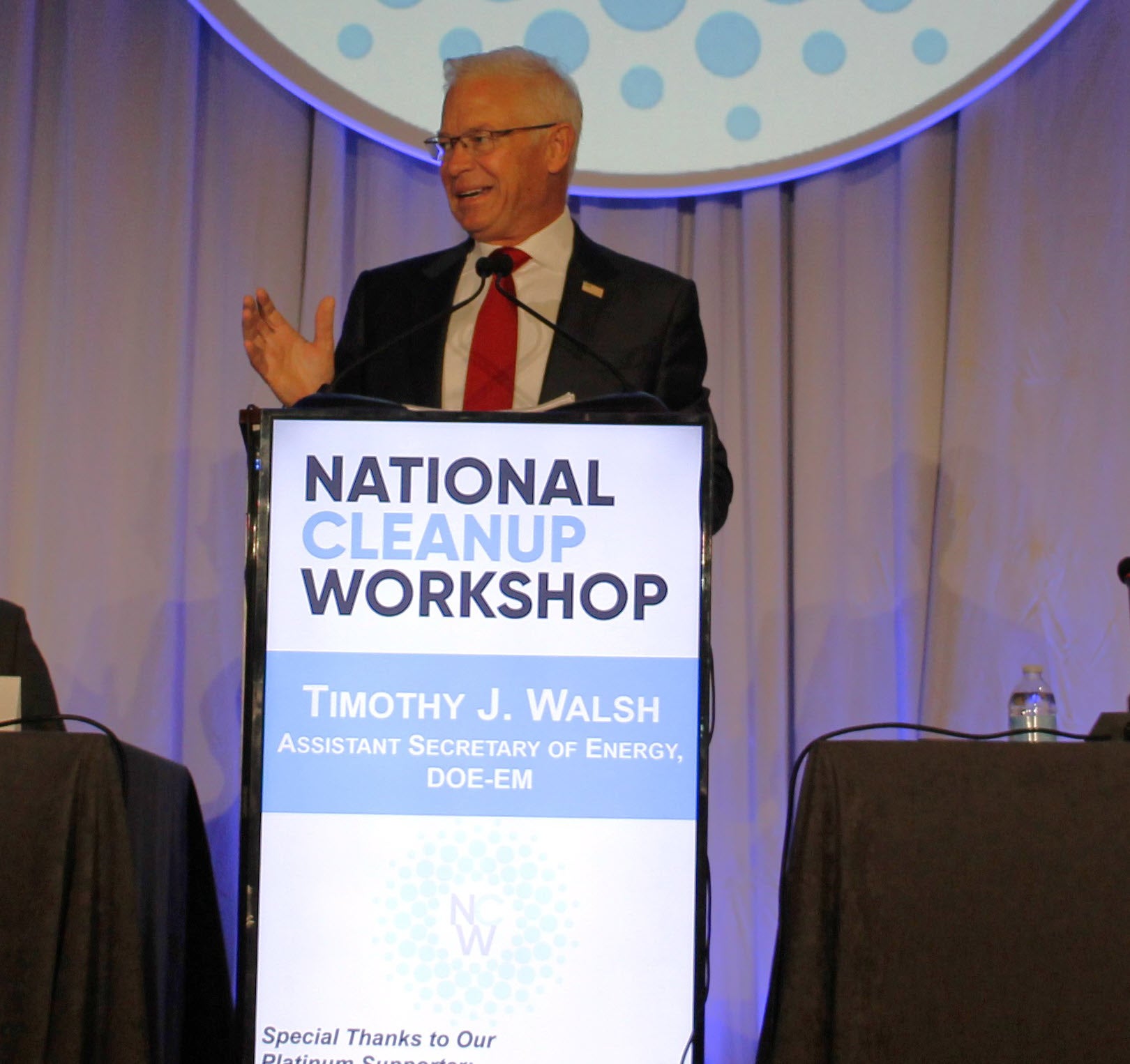
ARLINGTON, VA – Tim Walsh, the Department of Energy’s Assistant Secretary for the Office of Environmental Management (EM) said here Tuesday that his department is close to reaching an agreement with New Mexico officials over the Waste Isolation Pilot Plant (WIPP) near Carlsbad, N.M.
Walsh said EM has been in productive negotiations with the New Mexico Environment Department over the state’s proposed permit modifications for WIPP.
During an interview with Exchange Monitor following his speech here at the National Cleanup Workshop, Walsh predicted an agreement with New Mexico within days to address transuranic waste shipments from Los Alamos National Laboratory to WIPP.
“There was an agency-initiated permit modification from the state of New Mexico,” Walsh said. “We don’t need to rehash how we got here, but the issue is instead of litigating these matters as we have done in the past, we are rolling up our sleeves and having open and honest communications with the state of New Mexico.”
Environmental Management has been listening to concerns from the state and various stakeholder groups in New Mexico about cleanup of “the surface waste at Los Alamos,” Walsh said. The EM executive hopes DOE and the state will be able to sign “a mutually agreeable settlement” within days.
When reached Thursday, a New Mexico Environment Department spokesperson confirmed the state and the feds have been in serious discussions and are optimistic about getting a deal.
Also, moments before Walsh’s speech Environmental Management distributed a press release about a record number of transuranic shipments from Los Alamos to WIPP this year. Contractor Newport News Nuclear BWXT-Los Alamos LLC (N3B) has sent 82 waste shipments to WIPP this fiscal year, up from 43 shipments in fiscal 2025. This includes shipping corrugated metal pipe that has been buried many years at Los Alamos Technical Area 54’s Area G.
Meanwhile, EM continues to be in talks separately with Washington state over the scope of using a concrete-like grout to solidify some of the less radioactive waste from Hanford’s underground tanks.