Holtec International confirmed in a press release Thursday it is pausing its planned initial public offering (IPO),due to a combination of market factors including plummeting support for artificial intelligence data centers.
“The decision to postpone the offering has been caused by the unusual confluence of developments that has impaired investor confidence in the market for new public offerings,” according to the release. “The adverse market sentiment has affected the equity markets in general and the nuclear sector in particular in the past two weeks.”
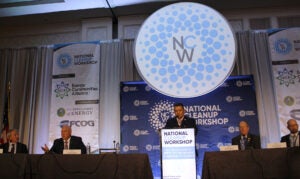
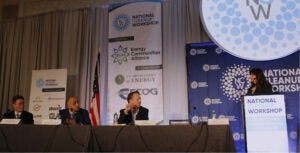
ARLINGTON, Va. – The Nuclear Regulatory Commission is working to address management of greater than class C (GTCC) waste through a recent rulemaking, Commissioner Matthew Marzano said Wednesday here.
The NRC Commissioner opened up the final day of the Nuclear Cleanup Workshop with a keynote address focused on the NRC’s role in the cleanup sector. The rulemaking, published in the Federal Register on July 1, proposes a framework for land disposal of low-level radioactive waste by allowing disposal facilities to manage a broader range of nuclear materials. It also aims to create a pathway for disposal of GTCC radioactive waste, which has a higher concentration of radionuclides than other low-level waste types.
As part of the rulemaking, NRC will maintain authority over GTCC radioactive waste disposal. However, Marzano said the public has had questions about whether NRC Agreement States or the NRC itself should have that authority. While Marzano did not answer that question, he said the comment period is important in helping the agency figure out which direction it should go.
The Baltimore District of the U.S. Army Corps of Engineers recently announced it has finished decommissioning and tearing down the 1950s era nuclear power reactor at Fort Belvoir, Va.
In a Sept. 10 news release, the Corps said it has finished dismantling the SM-1 Former Nuclear Power Plant, near the Potomac River, about 20 miles south of Washington, D.C. In addition to being the Army’s first power reactor, it was also the first nuclear unit to provide electricity to the commercial power grid over a prolonged period, the Corps said in the press release.
SMI-1 went online in 1957 as part of the Army’s Nuclear Power Program and it operated until 1973. The environmental cleanup work has been planned since 2014, the Army Corps said in the news release. The Corps obtained a decommissioning permit in 2020 and work started in 2021.The work was done by an Aptim-Amentum contractor team.
Senate and House Democratic appropriators are seeking answers from Secretary of Energy Chris Wright over Project Velocity, a DOE effort to revise operating directives at national laboratories and nuclear security sites.
Sen. Patty Murray (D-Wash.), and Rep. Marcy Kaptur (D-Ohio), ranking members of the Senate and House Energy and Water Development Appropriations subcommittees, said in a Sept. 16 letter that DOE’s changes could affect nuclear safety, project management and federal oversight.
DOE announced Aug. 13 that it had revised 46 directives and canceled four others as part of Project Velocity. The department has described the initiative, born from an October 2025 memo, as a shift from “prescriptive procedural compliance” toward “performance-based accountability,” while saying modernization will maintain safety and security standards, according to the letter.
Small modular reactor developer Deep Fission installed and retrieved its full-size prototype reactor canister from a borehole in Kansas, the company said Sept. 10.
According to the company’s press release, Deep Fission’s workers lowered its 20-foot canister to 100 feet below ground in a 34-inch wide borehole and then brought it back up to ground level. It said the demonstration took place on Sept. 3 and was conducted with commercial drilling equipment and drilling crew. Deep Fission received the prototype canister at its Parsons, Kan. site in July.
As a prototype, the canister is a full-size, non-nuclear version of the reactor core for the Gravity reactor the company is designing. The Gravity reactor is designed to be a standard pressurized water reactor with a power output of 15 megawatts.
The area around the Department of Energy’s Paducah Site in Western Kentucky experienced a rare event last month that some headline writers dubbed a “quake-nado,” in which a tornado and an earthquake strike at the same time.
The U.S. Geological Survey recorded a 2.5 magnitude earthquake centered in Massac, Ky., about eight miles from Paducah, around 4:35 a.m. Central Time on Aug. 20. Also, on Aug. 20, an EF1 tornado with winds around 100 miles per hour touched down in Lowes, Ky., about 22 miles from Paducah.
The Kentucky Geological Survey deemed the time of the events a coincidence, according to published reports. There was a quake-nado reported in Oklahoma in 2011.
The New Mexico State Land Office issued an executive order Sept. 4 that would ban any new uranium mining activities in the state.
The order, issued by New Mexico Land Commissioner Stephanie Garcia Richard, pushes for the state agency to prioritize nuclear cleanup at legacy uranium sites, according to a press statement. It will also push for the uranium industry and federal government to address the state’s legacy complications caused by uranium production.
The state holds the second-largest uranium reserve in the United States, behind Wyoming, with Grants, N.M. becoming one of the most prominent uranium ores, known as the Grants Minerals Belt. While New Mexico produced a lot of uranium in the 1950s, by the late 1990s it completely stopped uranium ore mining.
Former Sen. Jon Kyl (R-Ariz.), who served in Congress for 26 years and frequently spoke on issues of nuclear deterrence and the national laboratories on the floor, died at 84 Thursday.
Kyl was a member of the House of Representatives from 1987 to 1995, before serving as a Senator from 1995 to 2013. He briefly returned to the Senate in the final months of 2018 following the death of John McCain, but then resigned to make way for the appointment of Martha McSally.
“I was saddened to learn of Senator Jon Kyl’s passing yesterday,” a post on LinkedIn by the ANWA Deterrence Center said. Not long after he retired from the U.S. Senate, Jeff Crater and I found ourselves asking a difficult question: who would now champion our nation’s strategic nuclear deterrent—especially the vital work carried out by the NNSA and its national laboratories and weapons plants… His retirement marked the end of an era.”