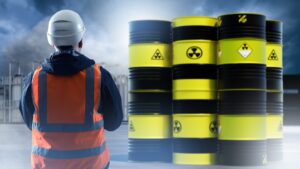
Many countries are searching to find a suitable deep underground geological repository for high-level radioactive waste in an effort to close the nuclear fuel cycle.
In June, the Nuclear Waste Technical Review Board held its spring meeting in Arlington, Va. with several international representatives sharing lessons learned in the siting process for a waste repository. Representatives from Czechia, Finland, Germany, Japan, South Korea and Switzerland participated.
Based on presentations at the meeting, here is an update on where these international deep geological repositories stand:
- Czechia is in the early stages of identifying a site for a deep geological repository for highly-radioactive waste and plans to have a site selected by 2030 and operating by 2050. There are feasibility studies across four shortlisted areas: Březový potok, Janoch, Hrádek and Horka. Czechia already operates three near-surface repositories for low- and intermediate-level radioactive waste.
- Finland is the furthest along as it is in the deep underground repository commissioning stage. Posiva, a Finnish nuclear waste management company, started the trial run for the Onkalo project in 2024, Some equipment is still in the testing phase. According to Posiva’s website, the company aims to start disposing of spent nuclear fuel by the end of this year.
- Germany has no operating nuclear reactors after it phased out its last three nuclear plants by 2023. But it is left with 10,500 tons of heavy metal spent nuclear fuel. Germany has begun identifying regions and has conducted representative preliminary safety analyses.
- Japan has since 2020 opened a solicitation for feasibility studies, what it calls literature surveys, for a deep geological repository.The most recent occurred in May in Minamitorishima, which is a remote Pacific island. The country plans to include storage of high-level waste and transuranic waste at its geological repository.
- South Korea plans to have an interim storage facility for high-level waste disposal in operation by 2050 and a deep geological repository at the same site by 2060. The country is currently in the pre-selection process phase. Also in 2023, South Korea started to build an underground research facility to test disposal technologies. Construction should be completed by 2032. Taebaek City is the site that will host the underground research facility.
- Switzerland is planning to build two deep geologic repositories: One for low- and intermediate-level waste and another for high-level waste. The country hopes construction of the facilities starts within a decade or so. Switzerland started its selection process in 2008 and selected the Nördlich Lägern region in northern Switzerland. Nagra, Switzerland’s national cooperative for disposal of radioactive waste, submitted a license application for a deep geological repository project, Terradura, in 2024. The site is in project development. According to Nagra’s website, the company expects a license decision to be made by 2031 and construction for the facility in the mid-2030s.
As many countries are making progress towards a deep geological repository, the United States is currently at a standstill when it comes to a national centralized waste disposal after the cancellation of the Yucca Mountain project in Nevada during the Barack Obama administration.
The Department of Energy published a request for information (RFI) in January about its nuclear lifecycle innovation campuses. These hubs are planned to address the many aspects of the nuclear fuel cycle, including waste management.
The solicitation for the RFI closed on April 1 and Energy Secretary Chris Wright said 28 states responded.