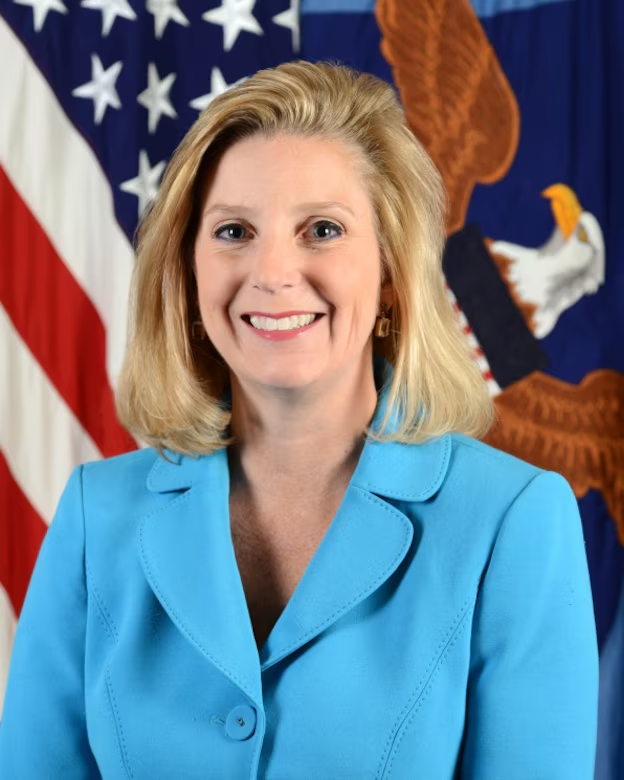
Christine Wormuth, chief executive officer of Washington think tank Nuclear Threat Initiative, said in a Thursday webinar a ground operation to seize Iran’s enriched uranium would be “extraordinarily complicated.”
For the past couple of weeks, there have been reports the Donald Trump administration is considering deploying troops to secure the speculated 440 kilograms, or near 1,000 pounds, of highly enriched uranium (HEU) the International Atomic Energy Agency (IAEA) says remains in Iran from the strikes from June 2025’s Midnight Hammer strike on Iran’s key nuclear facilities.
“I have the highest regard for the U.S. military special operations forces. You know, they’re an incredible asset, and we’ve seen what they can do,” Wormuth said. “But an operation to go in and retrieve the, you know, almost 1,000 pounds of highly enriched uranium that is believed to be at Isfahan would be extraordinarily complicated, I think, and not quick. That’s a very important point.”
HEU constitutes uranium-235 that has been enriched anywhere from 20-93%, with anything past 90% making weapons-grade uranium, or uranium that can be used to build a nuclear weapon. What is left of Iran’s stockpile of uranium is enriched up to 60%, which could very shortly be enriched further to weapons grade levels and make ten nuclear weapons, IAEA has said.
Wormuth continued to say since the material is buried underground and any entrances to tunnels are covered in rubble from the June strikes, along with the fact that it is located 500 kilometers inland from the Iranian coast, “to get in there, you know, you’d have to bring a pretty large force, I think you’d have to have a lot of troops there to do perimeter security and to basically, you know, provide security and air cover, essentially, for any kind of operation.”
“And then you’d have to have very highly specialized teams, which we have, that are trained to go in and deal with that very sensitive material,” Wormuth added. “But I think that would be an operation that would probably take days, given the complexity of it, and so I think it would be very high risk.”
Wormuth said there was the added risk of the HEU being hidden in different places. “If, in fact, the HEU is in more than one location,” that would mean “more than one operation to go and get it and to want to ensure, you know, as much as possible, protection of our troops,” she said. “You’d probably want to see those kinds of operations be conducted nearly simultaneously, which, again, just increases the difficulty factor of that kind of operation in a very real way.”
Wormuth spoke at a webinar on the future of Iran’s nuclear program with Scott Roecker, vice president of nuclear materials security at NTI, and Eric Brewer, deputy vice president of nuclear materials security at NTI.
This week, while the Trump administration has claimed Iran is ready to enter nuclear talks again with the U.S., Iran’s government has denied this and said on X it would only end the war if there is an “end to aggression by the enemy, concrete guarantees preventing the recurrence of war, clear determination, guaranteed payment of war damages and compensation, comprehensive end to the war across all fronts, incl. against all resistance groups, recognition of Iran’s sovereignty over Strait of Hormuz.”
Brewer also said he is skeptical Iran is as “eager” to enter talks again the way the Trump administration has claimed, especially one that calls for the “full dismantling of Iran’s nuclear program, dismantling of its proxy network, and some limits on its ballistic missile program.”
“There may be, you know, you may see some deal, deescalation eventually, and cessation of hostilities, but I think it’s very hard to see how a nuclear deal, a really robust nuclear deal, gets done anytime soon,” Brewer said.
Brewer added that with a “severely weakened conventional military and proxy capability, I think it’s really hard to see how the regime would want to hand over what is arguably its last remaining bargaining chip, and that is the ability to produce nuclear weapons,” especially if Iran might “mistrust commitments” from the U.S. when “we struck Iran in June 2025 while talks were ongoing, and then again in late February” when the foreign minister of Oman claimed it was overseeing talks between the U.S. and Iran that were making progress.
“If we do make it back to serious nuclear negotiations at some point, I think it’s important again to recognize that this is not the nuclear program of 2015,” Brewer concluded. “Iran has made significant technical progress,” since then, and “gained valuable skills and expertise across a range of areas that are not really easy to unwind. And so this means that a future deal is going to need to be stronger than the [2015] Iran nuclear deal, especially when it comes to monitoring and verification.”