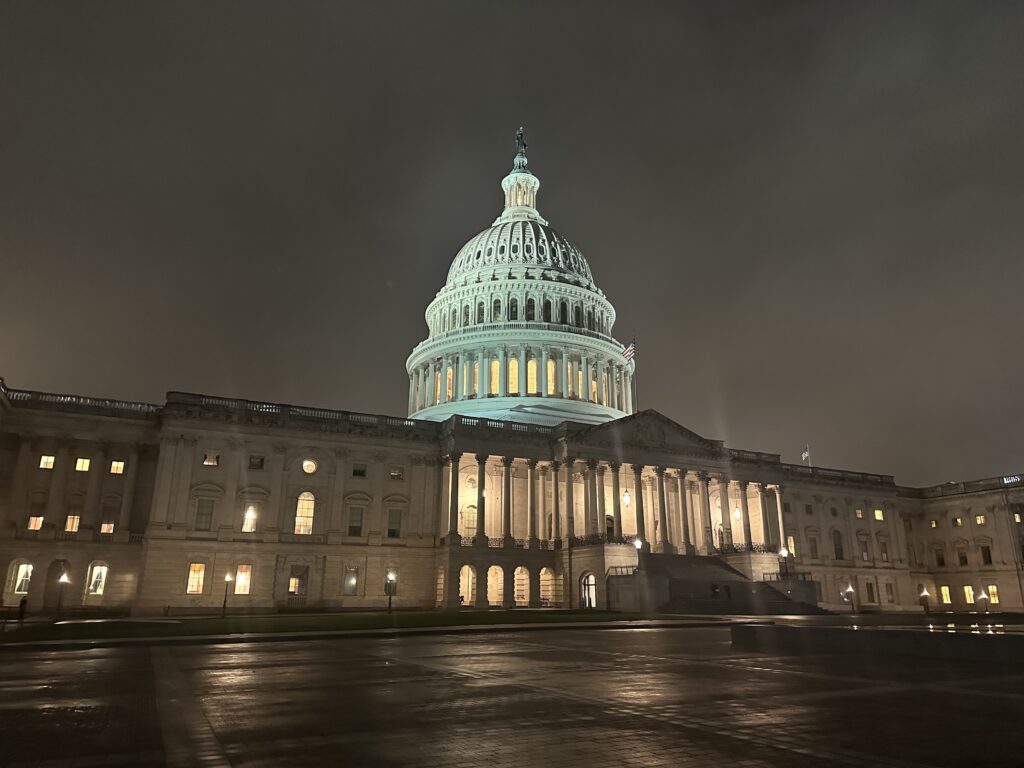
The House Energy and Commerce Committee advanced six nuclear energy-related bills out of committee to the full House after a three-hour markup hearing Wednesday.
The nuclear bills made up six of the 10 pieces of legislation approved during the markup. All nuclear bills were passed with bipartisan support with none receiving any no-votes. This comes after the same nuclear bills passed on a bipartisan basis out of the subcommittee in July.
“We took up several bills that highlight the committee’s effort to support energy innovation, cut burdensome red tape, and lower costs for hardworking American families,” Brett Guthrie, chair of the House Energy and Commerce Committee, said in a Wednesday press release. “We know that success for the nuclear industry—from the fuels, manufacturers, and reactors to the operators and workers—will be essential for long term American technological leadership globally and for reliable and abundant energy here at home.”
Here is a look at the bills:
- The Nuclear REFUEL (Recycling Efficient Fuels Utilizing Expedited Licensing) Act, introduced by Reps. Bob Latta (R-Ohio) and Scott Peters (D-Calif.), seeks to amend the Atomic Energy Act to incorporate “reprocessing spent nuclear fuel in a manner that does not separate plutonium from other transuranic elements.”
- The American Enrichment Deployment Act, by Reps. Russell Fry (R-S.C.), Kim Schrier (D-Wash.) and Erin Houchin (R-Ind.), would streamline licensing processes for uranium enrichment facilities.
- The Efficient Nuclear Licensing Hearings Act, introduced by Reps. Morgan Griffith (R-Va.), Schrier and Marc Veasey (D-Texas), would codify the Nuclear Regulatory Commission’s licensing decision to forgo a hearing when a license application is uncontested.
- The Department of Energy Nuclear Transparency Act, introduced by Rep. Kathy Castor (D-Fla.), seeks to increase transparency related to DOE’s nuclear facilities actions.
- The NRC Staff Pay Alignment Act, by Rep. Rob Menendez (D-N.J.), would amend the Atomic Energy Act to “provide compensation authority for certain appointees and for other purposes,” according to the bill.
- The Nuclear Advisory Committee Reform Act, introduced by Rep. Diana Harshbarger (R-Tenn.), seeks to update the role of NRC’s Advisory Committee on Reactor Safeguards in nuclear licensing and oversight.
During the markup, Peters, who represents a district near the shuttered San Onofre Nuclear Generating Station, said the Nuclear REFUEL bill is a solid first step to address nuclear waste.
“Making it easier to recycle and reuse spent fuel keeps it in reactors and away from communities, but also helps us keep a good reliable supply chain of fuel, which is good for national security,” Peters said.
Rep. Gabe Evans (R-Colo.), who represents the district where the decommissioned St. Fort Vrain nuclear power plant is located, said the Nuclear REFUEL Act was a commonsense policy that would put nuclear waste “to good use instead of just leaving it right now where it is in our communities.”
Houchin said the American Enrichment Deployment Act is essential in helping build out more enrichment facilities to support fuel needs of advanced reactors. This is particularly the case for small modular reactors (SMRs), which figure in Indiana’s energy plans, Houchin said.
Prior to the full committee’s markup, the House Energy and Commerce’s Energy subcommittee discussed the nuclear legislation in June with nuclear experts including former DOE official and now chair of University of Wisconsin’s Department of Nuclear Engineering and Engineering Physics, Kathryn Huff, as well as Jeffrey Merrifield, an attorney specializing in nuclear issues and former NRC commissioner.
Nuclear Energy Institute President and CEO Maria Korsnick, ClearPath CEO Jeremy Harrell and Huff told the House subcommittee panel that the American Enrichment Deployment Act is an urgent piece of legislation. Time is of the essence as the United States’ ban on Russian uranium will go into effect on Jan. 1, 2028, Harrell said.