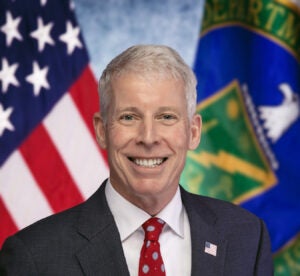
Rep. Eric Swalwell (D-Calif.), whose district abuts Lawrence Livermore National Laboratory, said this week he plans to resign from Congress and withdraw from the California governor’s race following a series of sexual misconduct allegations.
At this point at least four women, including a former staffer, accused Swalwell, with one saying he drugged her before assaulting her, according to BBC.
Swalwell’s lawyer says Swalwell denies “each and every” allegation, calling them “false, fabricated, and deeply offensive,” according to the statement on Swalwell’s Facebook page.
Huntington Ingalls Industries (HII) this week signed its second memorandum of understanding (MOU) with another “Physical AI” firm as it ramps up efforts to increase production through more automation.
The April 6 MOU aims to explore integrating GrayMatter Robotics’ Physical AI systems into HII’s shipbuilding operations, starting with a focus on autonomous surface preparation, coating and inspection technologies. This means HII is planning for its machines to focus on grinding, blasting and finishing metal structures, which involve very variable, complex and high precision techniques. This latest MoU comes after a similar agreement between HII and Path Robotics, with the focus there on welding steel for ships.
“By working with new Physical AI partners like GrayMatter Robotics and integrating them into our High-Yield Production Robotics (HYPR) initiative, we can further augment the HII workforce and speed up the shipbuilding process by bringing automation into more areas of production,” Eric Chewning, HII’s executive vice president of maritime systems and corporate strategy, told reporters, including Exchange Monitor affiliate Defense Daily, Monday.
The Trump administration’s nearly $1.2 trillion baseline defense budget request for fiscal 2027 will be adopted and will be the foundation for the “new normal” going forward, House Armed Services Committee Chairman Mike Rogers (R-Ala.) said on Sunday.
The “$1.15 trillion would be the new baseline,” Rogers said at a Space Leaders and Stakeholders Roundtable that helped kickoff the annual Space Symposium in Colorado Springs, Colo.
Rogers was responding to comments from industry participants on the panel who said the government needs to send consistent demand signals for space-related systems and capabilities to incentivize sustained private investment in the space sector. “I think we’re sending a pretty good signal right now,” Rogers said, highlighting that the baseline request is 35% more than Congress appropriated for the Defense Department in fiscal 2025.
The National Nuclear Security Administration (NNSA) removed all of the cesium-137 irradiators in South Carolina as part of the Cesium Irradiator Replacement Project, the agency said last week.
This makes South Carolina the 13th U.S. state, or U.S. territory, to clear high-risk cesium-137 radioactive material from the region. The other states as of yet are: Alaska, Arizona, Delaware, Idaho, Iowa, Kansas, Nevada, New Mexico, Oklahoma, Puerto Rico, South Dakota and Wyoming. NNSA also removed the last source of cobalt-60, another highly radioactive source, from Armenia, making the country free of all highly radioactive material.
These irradiators, often made from cesium or cobalt, are used for medical treatments including blood treatment and cancer research. However, the radioactive material inside is at risk for potential adversarial uses if stolen, including a “dirty bomb” or a mix of radioactive material and conventional explosives, the release said. Due to this risk, NNSA is working to replace the irradiators with alternatives. While the effort was first codified into law in the John McCain National Defense Authorization Act for fiscal 2019, according to the press release, NNSA has worked with facilities in South Carolina since 2017 to remove and replace radioactive technologies with alternatives.
The National Nuclear Security Administration and Lawrence Livermore National Laboratory are moving forward with a laser upgrade at the National Ignition Facility (NIF) with aims to support nuclear stockpile modernization.
The Enhanced Fusion Yield Capability project will increase the facility’s peak laser energy from 2.2 to 2.6 megajoules, according to the press release, improving its ability to simulate weapons conditions. The upgrade is designed to significantly boost fusion output, or the chemical reaction wherein two atoms combine with heat and pressure to create a big burst of energy similar to the inside of a nuclear weapon, enabling more experiments that underpin confidence in the U.S. nuclear deterrent without underground testing.
NIF already achieved a major milestone in 2022 by becoming the first facility to reach fusion ignition, and the new capability builds on that success. This project has reached an early approval stage, or Critical Decision-1, and is moving into design and procurement, with initial funding already appropriated. The lab also said this week it was partnering with Inertia, a fusion energy startup from San Francisco, in a research and development agreement focused on laser development and solving fusion problems.
The Department of Energy wants $10 million to fund the standalone Office of Fusion in fiscal 2027, according to DOE’s recent budget justification document.
DOE said the $10 million request will support the office by providing funding for personnel, travel, advisory and start up assistance. The Office of Fusion will lead DOE in advancing “a set of national priorities that establishes a national strategy to build, innovate and grow a leading, competitive and robust American-driven fusion energy industry,” DOE said in the document. It would also seek “to close scientific and technological gaps on the critical path toward commercializing fusion energy.”
The office was set up as part of DOE’s reorganization in November 2025. Several companion bills have been introduced in the House and Senate to codify establishment of the fusion-focused office. That way it would stick around in future presidential administrations. Fusion energy has seen a recent uptick in investment in the United States as the country races against China to achieve commercial fusion first. In 2022, the Lawrence Livermore National Laboratory in California became the first lab to achieve fusion ignition.
Anthropic and OpenAI, two competing artificial-intelligence companies that have done work in the nuclear weapons complex, are aiming to go public later this calendar year, major media outlets have reported.
Anthropic recently made the news when President Donald Trump directed federal agencies to cease any work with the company. The National Nuclear Security Administration said it will need to review its contracts with Anthropic, including a tool Anthropic was building to determine whether any knowledge obtained through its tools on nuclear weapons would be used for nefarious purposes.
OpenAI and its flagship ChatGPT tool are used at Los Alamos National Laboratoryon the Venado supercomputer, and the lab’s director Thom Mason told the ExchangeMonitor OpenAI models are used to sort through large amounts of testing data.
The White House’s Office of Science and Technology Policy unveiled in a Tuesday memorandum a new initiative focused on the use of nuclear power in space.
Within 30 days of the memorandum, the National Aeronautics and Space Administration (NASA) will create a program to develop a mid-power space reactor with a lunar fission surface power variant that can be launched by 2030, according to the National Initiative for American Space Nuclear Power, The plan will also have an option for a space variant for nuclear electric propulsion demonstration, according to the document. Conducting a parallel project to NASA, the Pentagon, depending on availability of funding, will pursue reactor deployment of an in-space reactor by 2031. Within 90 days of the memorandum, the Pentagon will hold a briefing with several White House offices to discuss which space nuclear system would be the best option.
Directed by the December 2025 executive order, Ensuring American Space Superiority, the new initiative, the National Initiative for American Space Nuclear Power, has laid out the guidance on how certain federal agencies will collaborate to deploy a nuclear reactor on the moon by 2030. The Donald Trump White House also wants a nuclear reactor deployed in orbit as early as 2028. The Department of Energy will support the overall mission for NASA and the Pentagon, according to the document. DOE entered into an interagency memorandum of understanding in January with NASA to collaborate on the moon reactor mission.
Rep. Marcy Kaptur (D-Ohio), ranking member of the House Appropriations Energy and Water Development Subcommittee, on April 8 unveiled a $19.2 million Department of Energy award to support a new nuclear safety training and workforce development program.
Kaptur spoke of the initiative, led by the University of Toledo, during a visit to the Davis-Besse Nuclear Power Plant in Oak Harbor, Ohio. According to Kaptur, the initiative builds on funding she authored in the fiscal 2024 Energy and Water appropriations bill, which set aside $100 million for nuclear reactor safety training programs. A second funding round for the remaining $50 million, given out by the Office of Nuclear Energy, is expected at a later date.
“This $19.2 Million award to the University of Toledo is the largest single federal award from the federal government in UToledo history and will reshape how the Federal government views university based nuclear research,” Kaptur said in her press release, which added the funding is distributing $50 million across 10 university-led projects nationwide. The Ohio-led effort is part of the Great Lakes Partnership to Enhance the Nuclear Workforce, a consortium that includes academic institutions, national laboratories, labor unions and industry partners such as Vistra Corp.