Delayed multi-ship contracts for 15 attack and ballistic missile submarines are finally expected in the second quarter of 2026, Huntington Ingalls Industries (HII) CEO Chris Kastner said in a company earnings call Tuesday.
Kastner said the company is “making good progress on the [Virginia-class submarine] Block VI and the next Columbia contract with awards expected in the second quarter.”
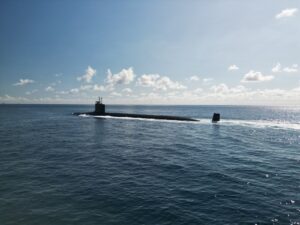
The Navy has been negotiating an overdue deal with HII and submarine prime contractor General Dynamics Electric Boat on awards covering 10 Block VI Virginia-class attack submarines (SSNs) and five Columbia-class nuclear ballistic missile submarines (SSBNs). The two shipbuilders split production of each submarine.
Beyond the ship program specifics, Kastner said HII had a “solid first quarter” with shipbuilding sales growth of 18% year over year, driven by increasing throughput in the shipyards as well as broader government and industry efforts to improve the maritime industrial base.
HII posted revenue of $3.1 billion, up 13% from a year ago while operating income was down $155 million with an operating margin of 5% compared to $161 million and 5.9% in the first quarter of 2025. HII said the segment’s lower operating income was driven by lower equity income from nuclear and environmental joint ventures, partially offset by higher performance in warfare systems.
First quarter earnings at $149 million are the same as a year ago, with diluted earnings per share also matching at $3.79.
HII cited new contract awards in the first quarter of the year totaled $4 billion, bringing the backlog to $54 billion.
HII’s Newport News Shipbuilding segment had a 19% increase in revenue from nearly $1.4 billion to $1.7 billion. Segment operating income rose 3.5% from $85 to $88 million due to higher volumes of aircraft carrier, submarine and naval nuclear support services.
During the Tuesday call, HII President of Newport News Shipbuilding Kari Wilkinson added the company has made “good progress on the framework for both Virginia-class Block VI and Columbia build two and anticipate contract awards in the second quarter, demonstrating our continued commitment to increase submarine delivery cadence.”
When pressed by an analyst about the sticking points in finishing the contracts, Kastner said, “I just think it’s a large contract that needs significant review and approval, and it’s complicated, and we’re just going through the approval process…it’s a significant, very important contract that we all need to get right.”
In early March, President of Electric Boat Mark Rayha told reporters he thought industry and the government were close to a deal that was just a few more months out.
Also in March, Rep Joe Courtney (D-Conn.), ranking member of the House Armed Services Seapower and Projected Forces subcommittee and representing the district containing GD’s submarine shipyard, wrote a letter to Under Secretary of Defense for Acquisition and Sustainment Michael Duffey pushing DoD to sign the contracts soon.
In March, both Rayha and Kastner mentioned the Defense Department setting up the new office of the Direct Reporting Program Manager (DRPM) for submarines was likely a factor in completing the deal as the Pentagon was trying to get the organizational structure set. The Senate confirmed Vice Adm. Robert Gaucher for the role in January.
Tom Stiehle, HII’s chief financial officer, underscored HII is working closely to finalize and execute the contract modification for the submarines and is “comfortable with where we are making meaningful, good progress with our customer on this front.”
Kastner said beyond fiscal issues, it is important to get the new submarines under contract on an operational level because “we need to stay on schedule, need to stay in sequence on the submarine program.”
Separately, Kastner said the company will not necessarily compete for the large auxiliary ship procurement the Navy is seeking in the fiscal ‘27 budget request given their future plans of working on both the FF(X) frigate at BBG(X) Trump-class battleship at the Ingalls Shipbuilding facility in Pascagoula, Miss.
“We’d have to evaluate those kind of on a case by case basis,” he said. “But there’s plenty of work at Ingalls, when you look at their baseline business, battleship, frigate, which we know we’re going to build. Battleship – we’re just at the beginning of the design effort with the Navy.”
The fiscal ‘27 budget request doubles the ship count enacted in the fiscal ‘26 budget, largely on the back of vastly increasing the demand for auxiliary ships.
Kastner left the door open, though, noting they will evaluate that based on how the effort and acquisition strategies unfold.
Exchange Monitor affiliate Defense Daily first posted a version of this story.