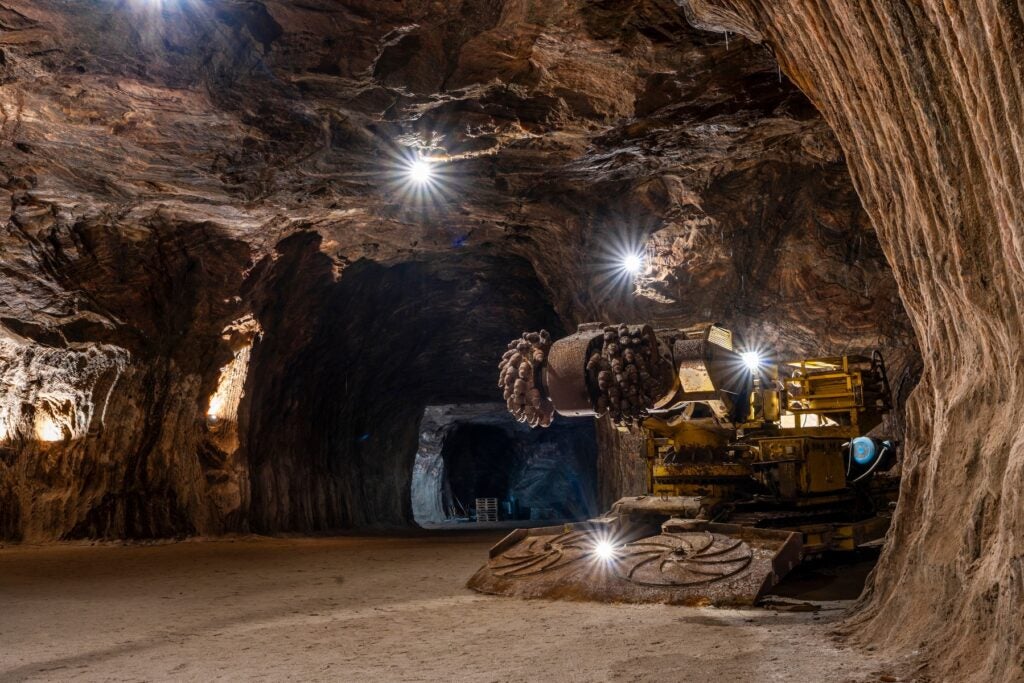
Underground operations at the Department of Energy’s Waste Isolation Pilot Plant (WIPP) in New Mexico are being suspended until probably mid-August, DOE told the New Mexico Environment Department (NMED) this week.
WIPP, the nation’s only deep disposal site for defense-related transuranic (TRU) waste, is pausing underground emplacement while it repairs a pair of hoists.
In May, both the Air Intake Shaft Hoist and the Salt Hoist “were taken out of service due to failed equipment and a faulty motor” at WIPP, a DOE spokesperson said in a Wednesday response to an Exchange Monitor inquiry. “Mechanical parts have been ordered and the failed motor has been sent offsite to be rebuilt,” the spokesperson added.
Because WIPP is required by the Labor Department’s Mine Safety and Health Administration to maintain two operational hoists to ensure safe underground ingress and egress, “underground access is not permitted until the transition of Shaft 5 to an emergency egress hoist is complete,” the spokesperson said. “Once complete, WIPP will have two operating hoists.”
The subject was addressed briefly Wednesday by DOE Carlsbad Field Office Manager Mark Bollinger, who spoke during a panel discussion at the Energy Facility Contractors Group meeting in Washington, D.C. The proceedings were also made available via Zoom.
“And right now we have not emplaced waste in two months,” Bollinger said. That is because of “100-year-old motors we are still trying to use, and we have a project to get them done, but that project has not been funded in the way we need it funded.” DOE has called the hoisting project key to long-range operation of WIPP.
Problems with the aging hoists were discussed in a recent Defense Nuclear Facilities Safety Board (DNFSB) staff report.
Bollinger made his assessment after alluding to ongoing tension between the DOE Office of Environmental Management and NMED. The state is seeking to reopen and modify the WIPP permit only two years after revising the document. New Mexico continues to push for WIPP to increase its shipment rate from the Los Alamos National Laboratory.
“We are under attack from the state of New Mexico right now and they would basically have us largely close if they got their way,” Bollinger said.
“Many of you are participating in the process to defend us and I thank you because our WIPP is your WIPP,” Bollinger told the contractor group. “So anyway, I want to plead for your continued support in whatever way you can to remember the waste has to go somewhere from doing all this [cleanup] work,” he added.
WIPP received 23 TRU waste shipments in May, with the last one arriving May 26, according to WIPP’s public database.
On Tuesday, Bollinger and the program manager for WIPP’s Bechtel-led prime contractor wrote NMED and said “underground access and shipments have been temporarily suspended.” It is anticipated that the Air Intake Shaft will be operational by mid-August 2026.
The DOE and contractor executives asked NMED for a 60-day extension on how long it may keep contact-handled TRU drums at a waste handling building and storage bay – and even the WIPP parking lot.
Some containers are approaching their respective storage time limits under the NMED state permit, according to the letter.