Andrew Hugg, the chief of nuclear safety for the Army, was seen in videos on X Thursday divulging sensitive information about the U.S.’s presence in Iran and is now on administrative leave from the Army.
The videos were posted by James O’Keefe, a conservative journalist known for founding Project Veritas and the O’Keefe Media Group.
“We have placed Mr Hugg on administrative leave while we conduct a thorough investigation into this matter,” a spokesperson for the Army told media outlets.
The Pentagon early Wednesday evening suddenly announced Secretary of the Navy John Phelan was immediately leaving the administration.
Under Secretary of the Navy Hung Cao will serve as the acting Navy Secretary.
“Secretary of the Navy John C. Phelan is departing the administration, effective immediately,” Pentagon spokesman Sean Parnell wrote on X. “On behalf of the Secretary of War and Deputy Secretary of War, we are grateful to Secretary Phelan for his service to the Department and the United States Navy. We wish him well in his future endeavors.” The Pentagon did not disclose why Phelan was leaving the job.
Los Alamos Technical Associates (LATA) has promoted Cory Tackett to assistant vice president supporting the Department of War Programs, the company said in a press release.
In the role, Tackett will help oversee programs at the Defense Department tied to the National Nuclear Security Administration’s (NNSA) weapons activities portfolio. Tackett’s 13-year tenure at LATA consists of time as a project manager for groundwater and environmental systems operations and maintenance on several of the company’s major government and commercial programs. He has degrees in systems engineering and chemistry.
LATA is a women-owned small business based in New Mexico specializing in engineering, environmental remediation and nuclear waste management for the Department of Energy, NNSA and the Pentagon. It has been involved with DOE weapons complex sites including Los Alamos and Sandia National Laboratories in New Mexico, Rocky Flats in Colorado, the Hanford Site in Washington state, the Oak Ridge Site in Tennessee and Idaho National Laboratory. LATA is also a small business teaming contractor to Bechtel’s Salado Isolation Mining Contractors at the Waste Isolation Pilot Plant near Carlsbad, N.M.
Sandia National Laboratories is advancing construction of its new Power Sources Capability (PSC) facility, a major infrastructure project supporting the nuclear security mission, the lab said last week.
The lab in New Mexico held a ceremony April 14 for the installation of the final beam in the facility, according to a press release. The roughly 136,000-square-foot building will consolidate power source research, design and production activities currently dispersed across multiple facilities. The project is intended to replace aging infrastructure and provide flexibility for evolving mission requirements.
The release said the PSC facility, which will cost around $400 million once finished, will enhance capabilities tied to national security applications. Construction began August 2025, with construction expected to be completed in 2028.
Santa Clara, Calif.-based Oklo made several personnel changes in key management positions and to its board of directors last week.
Oklo appointed four new directors on April 14. The board members are David Christian, David Park, Derek Kan and Mark Peters. The appointments were made effective April 10, according to Oklo’s press release.
“As we begin to build a wide range of facilities required to achieve our ambitious goal of jumpstarting the advanced nuclear energy sector in the United States and around the world, we are excited to lean on the decades of experience that they bring to our board,” Oklo co-founder and CEO Jacob DeWitte said.
At the Y-12 National Security Complex, officials are integrating advanced conveying technology from MagneMotion into the Uranium Processing Facility (UPF), according to the site’s website.
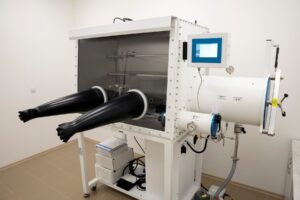
The system uses a type of motor technology to move materials, replacing traditional conveyor methods with independently controlled carts. It has been used in the automanufacturing industry, and is said to allow “gloveboxes to remain sealed, preventing contamination outside the gloveboxes.”