House Passes FY’16 Defense Authorization Act

Kenneth Fletcher
NS&D Monitor
5/15/2015

In the face of a White House veto threat over concerns including nuclear policy provisions, the House late this week passed its version of the Fiscal Year 2016 National Defense Authorization Act in a vote of 269 to 151. The bill sets authorized funding levels and policy for nuclear weapons and nonproliferation. Notably, a provision agreed to late this week during House floor debate would limit funding for implementing the New START arms reduction treaty with Russia until a number of conditions have been met. According to the amendment introduced by Rep. Doug Lamborn (R-Colo.), none of the funds in FY 2014 would be made available for New START implementation until the Defense Department and the State Department certifies that Russian armed forces “are no longer illegally occupying Ukrainian territory” and that Russia is “respecting the sovereignty” of the Ukraine. Additionally, Russia cannot be taking actions that are “inconsistent” with the Intermediate-Range Nuclear Forces Treaty and in compliance with the Treaty on Conventional Armed Forces in Europe and that there are no “inconsistencies” by Russia with regards to New START requirements.

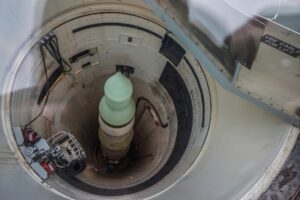
The House also approved by voice vote an amendment introduced by Rep. Cynthia Lummis (R-Wyo.) that would prohibit reducing the alert posture of the intercontinental ballistic missile force. The amendment states that the existing responsiveness and alert levels of the ICBM force are “critical” to providing “robust nuclear deterrence and assurance.” The amendment also states that reducing the responsiveness would be “deeply harmful” to national security and strategic stability in a crisis. Specifically, the provision prevents funding to reduce or preparing to reduce ICBM alert levels, while protecting ICBM maintenance and sustainment from a funding cuts.

White House Opposes MOX Provision

Before final passage of the bill, the White House released a statement of administration policy emphasizing that White House senior advisers would recommend a presidential veto without significant changes to the Committee version of the NDAA. Among provisions in the legislation opposed by the White House is a requirement to carry out construction of the Mixed Oxide Fuel Fabrication Facility, which the Administration last year moved to suspend. “This language is unnecessarily restrictive and would preclude alternative, and potentially more cost-effective approaches to implementing U.S. commitments in the 2000 Plutonium Management and Disposition Agreement and its 2010 annex to dispose of excess weapons plutonium,” according to the Administration statement.

The Administration also stated its opposition to NDAA language that would limit funding for nuclear weapons dismantlement, as well as a section that would limit and condition authorizations of technology transfers and assistance to countries that have a Naval Nuclear Propulsion Program. Additionally, the Administration is opposing a provision in the bill that “would limit funds for nonproliferation or arms control verification or monitoring technologies from being used to develop technologies beyond technology readiness level (TRL) 5 unless certain requirements are met.”

Additionally, it is opposing a requirement for the Department of Energy to develop a schedule for transfer of excess facilities held by the National Nuclear Security Administration to the Office of Environmental Management for cleanup. Early this year DOE established a working group “that is already developing an analysis and options for how the Department may prioritize and address the numerous contaminated excess facilities owned by the various DOE program offices,” according to the Administration statement. “The path forward for disposition of these facilities should be determined through this ongoing analysis and appropriate planning, not a required three-year timeline for transfer.” 
In This Issue


More on This Topic


Senate appropriators’ $1.07 trillion defense bill shifts $69 billion from reconciliation

Senate GOP appropriators’ $1.07 trillion fiscal 2027 defense bill shifts nearly $69 billion in Donald Trump administration reconciliation requests, cutting shipbuilding and research and development (R&D) accounts to offset the added funding.

The upper chamber’s defense spending bill proposal arrives as lawmakers face a looming government shutdown deadline on Dec. 11 and a waning number of workdays to craft final appropriations and policy bills before majority control shifts to Democrats when the new Congress begins in January.

The defense appropriations bill funds the procurement, operation, modernization and maintenance of the nuclear triad’s delivery and command systems.

Overall, the bill includes $42 billion for shipbuilding, covering an additional $1.9 billion for a second DDG-51 destroyer, as well as incremental funding for one Columbia-class submarine and two Virginia-class submarines.

President Trump and Defense Secretary Pete Hegseth have recently reiterated the administration’s push for Congress to pass at least $350 billion in defense funds via the reconciliation process to achieve a total $1.5 trillion fiscal year 2027 topline. 

While a pathway has yet to form for how congressional Republicans may move forward on passing a large party-line defense funding bill, the Senate appropriators’ bill shifts over a portion of the requested mandatory spending funds over to their defense spending bill.

Sen. Chris Coons (D-Del.), who is in line to be the Senate’s top defense appropriator beginning in January, threw cold water last week on any GOP plans for a $350 billion reconciliation bill, or any defense reconciliation bill, before a new Congress is sworn in early next year. 

Senate appropriators’ $1.07 trillion topline largely aligns with the funding level approved by House appropriators over the summer, although the measure may have challenges garnering support from Democrats who are seeking to use the legislation as a means of curbing the Trump administration’s ongoing military campaign against Iran. 

“This bill delivers a truly massive windfall for Pete Hegseth’s Pentagon—meeting President Trump’s eye-popping request—while doing next to nothing to rein in this president who is waging illegal wars,” Sen. Patty Murray (D-Wash.), the Appropriations vice chair, said in a statement.

Murray is in position to take over the Senate’s top appropriator in the new Congress while the Senate GOP’s top two defense appropriators are set to exit, with Sen. Mitch McConnell (R-Ky.), 84, retiring and current Appropriations Chair Susan Collins (R-Maine) losing her reelection bid. 

While Congress passed $150 billion in defense funds in last year’s reconciliation bill, Senate appropriators have pushed back on the Trump administration’s use of bifurcated budget again in their explanation for shifting over $69 billion in items from the mandatory spending request. 

Navy shipbuilding was among the most significant “bill-payers” to account for the mandatory spending shift over to the appropriations, with the $18.5 billion including $5.6 billion from the Columbia-class submarine program, $4.6 billion from the Virginia-class submarine program and the entire $1 billion request for the BBG(X) Trump-class battleship. 

For the Navy, the R&D cuts include $585.9 million from “ship preliminary design and feasibility studies,” mostly due to BBG(X) cut, $313.4 million from the Conventional Prompt Strike program, $164.2 million from Collaborative Combat Aircraft (CCA) development due to “misaligned acquisition phasing,” $320.5 million from Standard Missile improvements, $462.2 million from TACAMO aircraft modernization and $158 million from MQ-25 Stingray work.

Cuts to the Air Force’s R&D account include $413.3 million from B-21 Long Range Strike Bomber development work, $292.9 million from test and evaluation support, $309.7 million for developing B-2 operational systems, $108.5 million from intercontinental ballistic missile reentry vehicles and $3.9 billion from classified programs.

Exchange Monitor affiliate Defense Daily first published a version of this story.

In This Issue

More on This Topic