The Pentagon is looking at competition in the software and support construction realms for the Northrop Grumman future LGM-35A Sentinel intercontinental ballistic missile (ICBM), a top official said last week.
The Air Force has been restructuring the program since July 2024 and expects Pentagon acquisition chief Michael Duffey to re-certify Sentinel for engineering and manufacturing development (EMD) this year – months ahead of the Air Force’s earlier estimate of early to mid-2027.
“As I came upon the program and did the research understanding the contract structures, one of the things I recognized was we had this very vertical structure, and what we’ve done is built an architecture in the restructure to find opportunity, specifically as it relates to construction and areas where, after we get design complete, we can open the aperture to have competition,” Air Force Gen. Dale White, the direct reporting portfolio manager for critical major weapon systems, told a House Armed Services Committee strategic forces panel hearing.
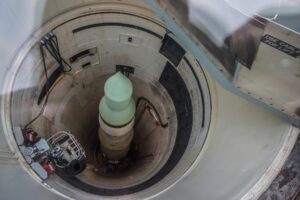
The Northrop Grumman-made Sentinel ICBM will eventually replace the Boeing-made Minuteman III as the Air Force’s silo-based, nuclear-armed ICBM. That is expected sometime in the 2030s while the Minuteman III is still commissioned. The new missile will initially carry W87-0 warheads provided by the National Nuclear Security Administration’s Lawrence Livermore National Laboratory in California, before transitioning to the W87-1 warheads being made at Los Alamos National Laboratory in New Mexico.
“One of the other areas I’m paying very close attention to is making sure we build a software architecture that allows us to have an opportunity to be able to compete into the future rather than typically what we do is have software that is very stove-piped, in a sense,” White continued. “Northrop Grumman is working with us on that, building that architecture and making sure it is open. If that architecture remains open, it allows us to continuously compete the systems and subsystems.”
White was responding to a question from Rep. Seth Moulton (D-Mass.), the subcommittee’s ranking member, on how he was ensuring that the structure of the Sentinel program would encourage “maximum competition” as “one of the best ways” to “force contractors to get down their costs.”
In February, construction of a prototype Sentinel silo began at Northrop Grumman’s Promontory, Utah, site, and the Air Force has said it expects to conduct the first flight test of Sentinel from a pad at Vandenberg Space Force Base, Calif., next year.
The Defense Department approved Sentinel to enter EMD in 2020, but then rescinded that decision in 2024 after a critical Nunn-McCurdy unit cost breach.
Initial operational capability for Sentinel was May 2029, but that shifted to the end of 2033.
Sentinel may get a new cost estimate this summer. Nearly two years ago, the Air Force pegged Sentinel cost at $140.9 billion, 81% higher than the September 2020 estimate when the program was approved for EMD–a rise that DoD said has less to do with the missile than the command-and-control segment, including siloes, launch centers, “and the process, duration, staffing, and facilities to execute the conversion from Minuteman III to Sentinel.”
The Air Force has budgeted $6 billion in research and development for Sentinel in fiscal 2027, including funds for air vehicle development, launch silo and launch center prototyping, flight test execution, and support upgrades.
Exchange Monitor affiliate Defense Daily first published a version of this story.